The Moment Every New Pilot Panics on the Radio
Learning to fly has gotten complicated with all the radio noise flying around — and I mean that literally. You’re climbing through 3,500 feet on a clear afternoon. Finally relaxed. Good takeoff behind you. Then ATC cuts through crisp and sharp: “Cessna 2-4-7 Bravo, climb maintain 5,000, contact departure on 119.3.”
You read it back. Switch frequencies. Key the mic.
Nothing.
Dead air. You’re probably on 119.2 instead of 119.3 — or maybe you heard it wrong entirely. Heart rate jumps. Workload explodes. By the time you find the right frequency and actually make contact, you sound flustered, the controller sounds annoyed, and you spend the next ten minutes second-guessing every number you copied. I’ve been there. Most pilots have.
But here’s the thing — it’s not because you’re bad at this. The radio handoff is the visible edge of an invisible system, one built on geographic boundaries, controller workstations, and airspace architecture that nobody bothers explaining until you’re already panicking at altitude. Today, I’ll share everything there is to know about why frequency changes happen, what’s actually going on behind them, and how to stop dreading them forever.
So, without further ado, let’s dive in.
How Airspace Sectors Drive Every Frequency Change
Probably should have opened with this section, honestly.
Every ATC frequency you’ll ever hear is tied to a physical chunk of airspace. Not a vague region. Not “somewhere over Kansas.” A sector — a defined three-dimensional box of air managed by a specific controller at a specific workstation inside a specific facility. That’s it. That’s the whole secret.
But what is a sector, really? In essence, it’s an assigned volume of sky with hard geographic edges. But it’s much more than that. It’s also a workload management tool, a data boundary, and the reason your radio ever crackles with a new frequency in the first place.
Approach control facilities — TRACONs — manage airspace roughly 5 to 30 miles around major airports, typically surface up to around 10,000 feet. En route facilities, the ARTCCs, control everything above that, sometimes across hundreds of miles of open sky. The boundaries between sectors don’t move. They don’t care about your flight plan, your route preferences, or the weather you’re detouring around.
When you transition from one sector to another — say, climbing out of Class C and entering ARTCC airspace — your aircraft physically leaves one controller’s responsibility zone and enters another’s. That’s the frequency change. Not a whim. Not FAA bureaucracy. A data handoff between workstations, mapped to a line drawn in three-dimensional space.
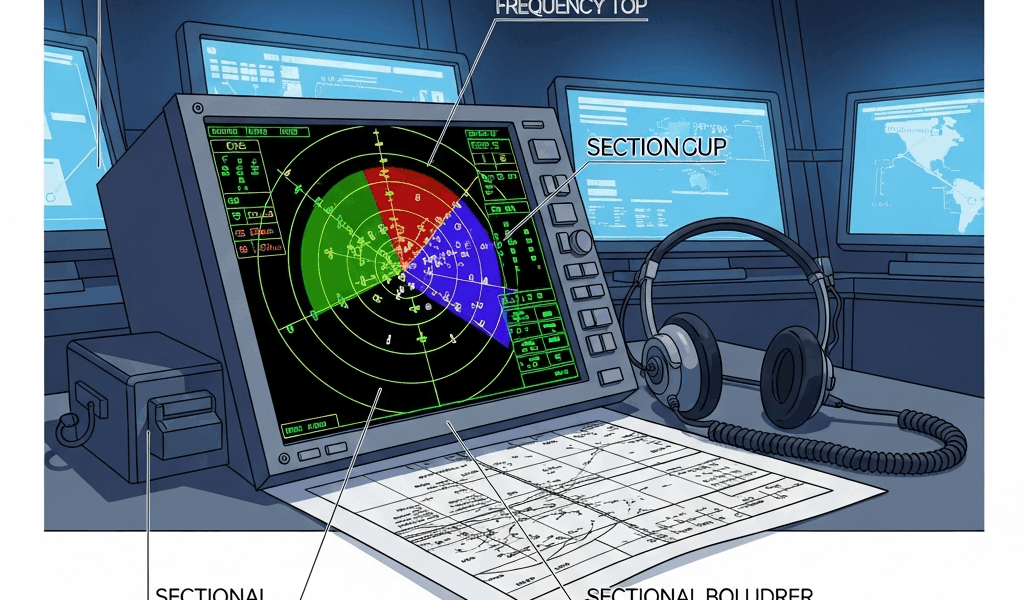
Each controller watches a radar scope showing every aircraft in their sector. Your blip carries data: tail number, altitude, heading, assigned altitude, sometimes your full route. Cross that sector boundary and your radar target moves off their scope and onto the next controller’s. The frequency change is how they tell you to follow it.
The infrastructure is relentless about this. A Beechcraft King Air climbing out of Atlanta doesn’t negotiate timing with ATC. The sector boundary sits at 8,000 feet. At 8,000 feet, you switch — because one controller managing 15 aircraft is sustainable, and one managing 40 is a safety crisis. The math doesn’t bend.
Why the Timing Always Feels Wrong
Here’s the frustration most pilots actually feel: the handoff instruction always seems to arrive at the worst possible moment. You’re mid-climb. Trimming. Cross-checking instruments. Mentally three steps ahead. Then the radio crackles with a frequency change.
The timing isn’t wrong. It’s just inevitable — at least if the sector boundary happens to fall where it falls.
Sector boundaries are geographically fixed. Your flight is dynamic. Climbing at 500 feet per minute, you’ll hit that boundary at whatever minute you hit it, regardless of whether you’re juggling one task or five. Controllers coordinate these handoffs in advance — there’s a landline call ahead of time, a quick brief to the receiving controller — but the actual handoff happens at a specific point in space, not a convenient moment in your personal workload cycle.
Most busy transitions stack up during climbs and descents. A climb-out from a busy airport might mean three frequency changes inside ten minutes. Descent into congested airspace might mean four. Each one is perfectly logical from the system’s perspective. Each one feels abrupt from inside the cockpit. That gap — between ATC telling you to switch and you actually making contact — is exactly where confusion lives.
You’re hunting for the frequency in cockpit clutter. The receiving controller is managing five other aircraft. You key the mic. Their scan misses you for three seconds. You immediately assume you’re on the wrong frequency. You’re not. You’re just in queue. Don’t make my mistake of immediately re-tuning out of panic — wait two full seconds before assuming anything.
What the Data Behind a Handoff Actually Looks Like
Understanding what happens beneath the radio call is where a systems perspective really changes things.
Every commercial aircraft — and most modern general aviation aircraft — broadcasts ADS-B data on 1090 MHz. Position, altitude, velocity, tail number, once per second, to ground receivers feeding into flight tracking platforms, air traffic management systems, and controller workstations simultaneously. Your Cessna exists as a data object in multiple networks at the same time.
When you cross a sector boundary, that data object transitions from one network to another. Pull raw ADS-B data from something like ADS-B Exchange or FlightRadar24 and you’d see your position stream continuously — no interruption, no gap. But on the controller’s scope, you disappear from one display and appear on the next. The frequency change is the synchronization point between those two worlds.
In systems with modern data integration — the kind aerodata.ai works with — you can actually watch this transition happen in real time. An aircraft’s radar tag crosses a sector boundary line. The controlling facility changes in the data. The assigned frequency changes in the system. Then the controller gives you the handoff instruction. It’s all connected, all traceable, all tied together by that one radio call that felt random from the cockpit.
That’s what makes frequency changes endearing to us aviation nerds, honestly. You’re not hearing chaos. You’re hearing the audible edge of a data handoff between systems. The frequency isn’t arbitrary — it’s the address of the next controller’s workstation.
How to Stop Dreading the Frequency Change
I’m apparently a paper-and-pencil frequency copier and a physical sectional chart works for me while purely digital cockpit management never really clicked — so take my workflow with that grain of salt. But the principles hold regardless of your setup.
First, you should build a mental model before you ever leave the ground — at least if you want the radio to stop feeling like an ambush. Study the sectional chart before takeoff. Identify the major sector boundaries you’ll cross. VFR sectionals label Class B and Class C airspace clearly and show ARTCC boundaries as blue lines. Know which facility controls which piece of sky along your route.
A standard departure from a Class C airport follows a predictable pattern: tower, approach (TRACON), departure, then regional ARTCC. These handoffs follow altitude and direction of flight. They’re not random. Once you’ve flown the route twice, you’ll start anticipating them automatically.
While you won’t need a full ATC facility map memorized, you will need a handful of tools: current sectional charts, a written frequency list for your route, and the habit of having the next frequency ready before you hear it called. “What’s my next frequency?” is a legitimate, professional question — ask it early if you’re unsure.
A paper kneeboard might be the best option here, as frequency copying requires speed and accuracy. That is because a misheard digit under pressure sends you hunting the wrong channel while the controller waits. Write the frequency down. Read it back. Give yourself the physical record.
Once you understand that frequency changes are manifestations of airspace infrastructure — not interruptions, not tests, not randomness — the radio stops sounding like something you’re failing. It sounds like a system doing exactly what it was designed to do. Your job is to follow the pattern. That’s manageable. That’s completely learnable. This new way of hearing the radio takes hold after just a few flights and eventually evolves into the situational awareness experienced pilots carry with them everywhere.



Stay in the loop
Get the latest aerodata updates delivered to your inbox.