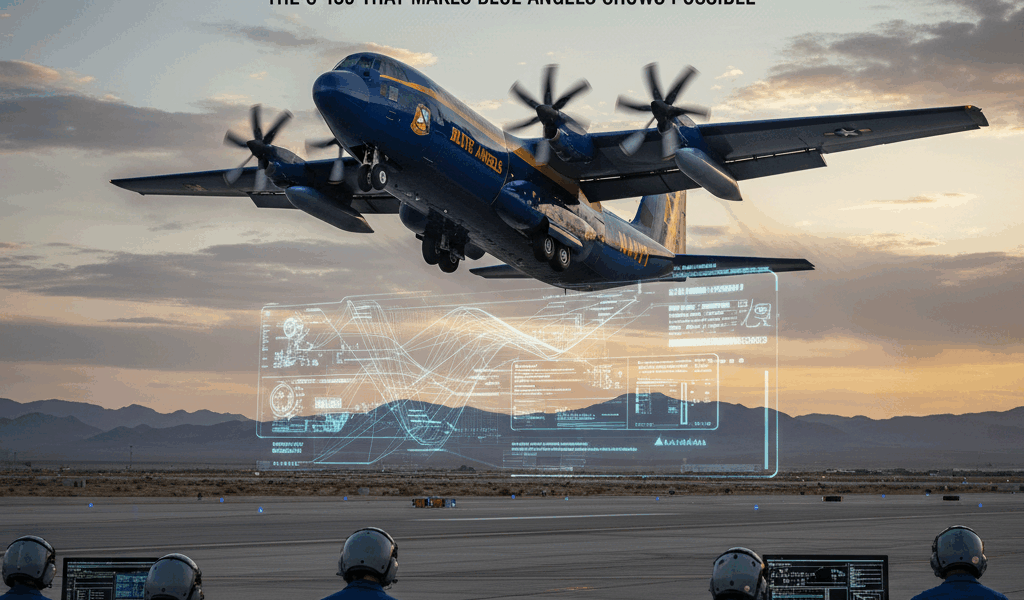
Fat Albert: The C-130 That Makes Blue Angels Shows Happen
Blue Angels air shows have gotten complicated with all the schedule changes and aircraft transitions flying around, but one thing has stayed constant for decades: before the F/A-18s take the stage, a big gray C-130 Hercules named Fat Albert does the heavy lifting. As someone who grew up watching Blue Angels shows and later worked around C-130s in the military, I learned everything there is to know about this aircraft and why it matters. Today, I will share it all with you.
What Fat Albert Actually Does
Probably should have led with this section, honestly. Fat Albert isn’t a stunt plane. It’s a logistics aircraft. Its primary job is hauling the Blue Angels’ support crew, spare parts, tools, maintenance equipment, and show supplies from one performance location to the next. The Blue Angels perform at roughly 30 air shows per year across the country, and all of that gear has to move with them. Fat Albert carries it.
The aircraft is operated by a Marine Corps crew, not Navy like the Hornet pilots. The Marines have been providing the C-130 and its crew to the Blue Angels since 1970. It’s a partnership that works because the Marine Corps uses the assignment as a high-visibility opportunity for their best C-130 aviators and maintainers.
When Fat Albert lands at a show site, typically a day or two before the main performance, the crew unloads everything the Blue Angels need. Toolboxes, nitrogen carts, hydraulic test stands, uniforms, PR materials. It’s essentially a flying warehouse that sets up shop at a new airport every week during show season.
The C-130 Hercules Platform
The C-130 first flew in 1954, designed by what was then Lockheed. The airframe has been in continuous production longer than any other military aircraft in history. More than 2,500 have been built, and variants serve in air forces around the world for transport, aerial refueling, search and rescue, firefighting, and special operations.
What makes the Herc uniquely suited to its role is the combination of payload capacity and short-field performance. Four Allison T56 turboprop engines generate enough power to operate from unpaved runways, austere airfields, and strips that would be too short for a comparable jet transport. That capability matters for the Blue Angels because not every air show venue is a major airport with 10,000 feet of concrete.
Key specifications:
- Engines: Four Allison T56-A-15 turboprops
- Wingspan: 132 feet 7 inches
- Length: 97 feet 9 inches
- Cruise speed: 320 knots
- Range: Over 2,000 nautical miles
- Max takeoff weight: 155,000 pounds
I’ve been inside C-130 cargo bays more times than I can count, and the interior is exactly as utilitarian as you’d expect. Exposed stringers, cargo rollers in the floor, red webbing seats along the sides. It smells like hydraulic fluid and JP-8. Nothing glamorous about it, which is honestly part of the appeal. It’s a truck that flies.
The JATO Days
For years, Fat Albert’s signature air show maneuver was the JATO takeoff. JATO stands for Jet-Assisted Takeoff, and it involved strapping eight solid rocket bottles to the rear fuselage. On the takeoff roll, the pilot would fire the rockets, and the C-130 would leap off the runway and climb at an angle that a 155,000-pound aircraft has no business achieving. The crowd reaction was always massive.
The JATO rockets ran out in 2009. The military’s stockpile of the solid-fuel bottles was exhausted, and no new ones were being manufactured. Without the rockets, Fat Albert’s demonstration became a more conventional display of tactical capabilities: short-field takeoffs, steep approaches, maximum-performance climbs. Still impressive for a four-engine turboprop, but different from the rocket-assisted spectacle that older air show fans remember.
That’s what makes Fat Albert endearing to us military aviation people. It’s not the fastest or the flashiest aircraft at the show. But it represents the essential reality of military aviation: before the fighters can fly, someone has to move the support infrastructure. Fat Albert does that job, and it does it in front of millions of spectators who get to see a working military transport doing what it was designed to do.
The Crew
The Fat Albert crew is a Marine Corps assignment. Pilots, flight engineers, loadmasters, and crew chiefs are selected from among the best in their specialties. The assignment typically lasts two to three years, which means the crew turns over regularly. Each new crew has to learn the show routine, the logistics rhythm, and the public-facing aspect of the job, which is a significant departure from normal military flying where you rarely interact with civilians.
The maintenance team keeps the aircraft mission-ready through a grueling show schedule. Fat Albert flies more hours per year than a typical Marine Corps C-130 because the show calendar demands constant repositioning. The maintainers work long hours in all weather conditions, often on unfamiliar ramp space with limited facilities. It’s demanding work that doesn’t get the recognition it deserves.
Fat Albert’s Legacy
Multiple C-130 airframes have carried the Fat Albert name over the decades. The current aircraft, a C-130J Super Hercules, replaced the older C-130T in 2020. The J-model brings updated avionics, more powerful engines, and improved performance, but it’s still recognizably a Hercules. The blue and gold paint scheme makes it instantly identifiable at any airfield.
The aircraft has appeared in documentaries, news features, and countless air show highlight reels. It has its own following among aviation enthusiasts, separate from the Hornet formation that gets most of the attention. There are people who show up to Blue Angels events primarily to see Fat Albert, which tells you something about the character of the aircraft and its crew.
At every Blue Angels show, the Hornets get the applause. Fat Albert gets the respect. Both are earned.
Recommended Aviation Gear
David Clark H10-13.4 Aviation Headset – $376.95
The industry standard for aviation headsets, trusted by pilots worldwide.
Pilot’s Handbook of Aeronautical Knowledge – $25.42
The official FAA handbook – essential reading for every pilot.
As an Amazon Associate, we earn from qualifying purchases.

Stay in the loop
Get the latest aerodata updates delivered to your inbox.