
Air Cargo’s Record-Breaking Year
Air cargo economics have gotten complicated with all the pandemic distortions and e-commerce hype flying around. Today, I will share it all with you.
That $170 billion figure for 2024 marks a huge transformation in how goods move across the planet. It’s down from the pandemic craziness, sure, but it still represents a fundamental shift in air freight’s importance to global supply chains — driven by online shopping, manufacturing reshoring, and companies that refuse to keep anything sitting in a warehouse longer than absolutely necessary.
Revenue vs. Volume: Understanding the Numbers
Here’s something that trips people up constantly. The $170 billion is total revenues, not volume. Actual tonnage moved by air has stayed relatively flat at around 60-65 million metric tons per year. So where’s the money coming from?
- Yield improvements: Average revenue per kilogram shipped jumped significantly compared to 2019 levels.
- Premium services: Time-definite delivery options command serious price premiums.
- Capacity constraints: Limited bellyhold space on passenger flights gives cargo carriers pricing power.
- Fuel surcharges: Volatile energy costs get passed straight through to shippers.
Who Moves Air Cargo?
The market breaks down into several distinct player types, and each one operates pretty differently:
- Integrated express carriers (FedEx, UPS, DHL): They own their planes and their ground networks. Handle roughly 45% of global air cargo by revenue. These guys control the entire chain.
- Combination passenger airlines: Your Deltas and Emirates of the world carry freight in the belly compartments underneath the passenger cabin. Emirates, Qatar Airways, and Lufthansa make serious money this way.
- Dedicated freighter operators: Pure cargo outfits like Cargolux, Atlas Air, and Kalitta Air running routes with heavy freight demand. No passengers, no cabin crew, just boxes.
- Charter and ACMI providers: On-demand capacity for peak seasons and weird cargo that doesn’t fit the normal schedule.
E-Commerce Drives Structural Change
Cross-border e-commerce has completely rewritten the air cargo playbook:
- Small package explosion: Individual consumer orders — often under 1 kilogram — now represent a growing chunk of air freight. That changes everything about how cargo gets handled and sorted.
- New trade lanes: Direct flights from manufacturing hubs like Shenzhen, Zhengzhou, and Xiamen to Western consumer markets have multiplied. These routes barely existed a decade ago.
- Speed is non-negotiable: Two-to-three day international delivery is becoming the baseline expectation for premium e-commerce. That kind of timeline forces air freight over ocean every time.
- Returns create new flows: Reverse logistics — consumers sending stuff back to sellers or recyclers — generates cargo streams that didn’t exist before.
Top Air Cargo Routes
The busiest freight lanes connect where things get made to where things get bought:
- Hong Kong to North America: The single biggest air cargo lane on the planet by tonnage. Not even close.
- Shanghai to Europe: Heavy manufacturing-to-market flows keep these planes full.
- Anchorage hub: Most people don’t realize this, but Anchorage is one of the world’s busiest cargo airports because Asia-North America freighters stop there to refuel. Geography matters.
- Memphis and Louisville: FedEx and UPS built their entire hub operations here, making these smaller cities among the highest-volume cargo airports globally.
Aircraft Types in Cargo Service
The air freight fleet is a mix of purpose-built freighters and converted passenger planes finding second careers:
- Boeing 777F: The workhorse of long-haul cargo right now. Exceptional range and payload combination.
- Boeing 747-8F: Production’s over, but the 747 stays essential because it handles oversized cargo that literally won’t fit in anything else. That nose door is irreplaceable.
- Airbus A350F: The next-generation freighter coming in the next few years with better fuel efficiency. Everyone’s watching this one.
- Converted 767s and A330s: Old passenger jets getting gutted and rebuilt as freighters. It’s a huge market and gives these airframes 15-20 more years of useful life.
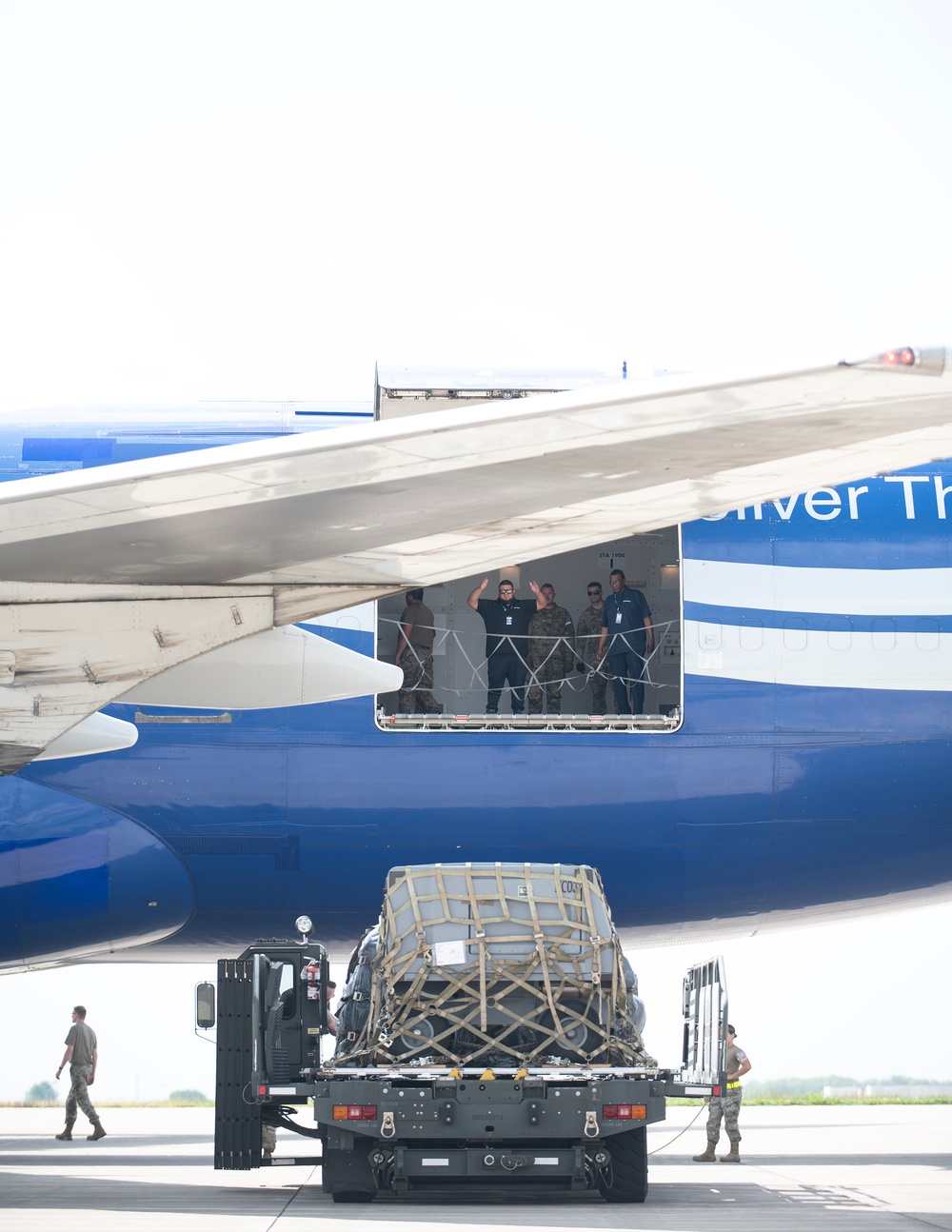
Pharmaceutical and Cold Chain Growth
Temperature-sensitive cargo is one of the fastest-growing segments, and it commands serious premiums. Pharmaceuticals, biologics, and vaccines need unbroken cold chain management from factory to hospital. Airlines have poured money into temperature-controlled facilities and specialized containers to grab this traffic. It’s high-margin and relatively recession-proof.
Market Dynamics Post-Pandemic
COVID created cargo conditions nobody had seen before. Passenger bellyhold capacity vanished overnight while e-commerce demand went through the roof. Several lasting effects came out of that period:
- Fleet growth: Cargo airlines placed big orders during the boom, and those planes are still being delivered.
- Accelerated conversions: Airlines fast-tracked retirement of older passenger jets to feed the conversion pipeline.
- Infrastructure buildout: Airports expanded cargo handling facilities to keep up with volume.
- Digital shift: Paper-based processes that had survived decades finally gave way to electronic documentation. The pandemic forced what years of industry initiatives couldn’t.
Challenges Ahead
Even with strong revenues, the air cargo industry faces real headwinds that keep operators up at night:
- Overcapacity risk: All those freighter orders from the boom years may deliver more capacity than the market can absorb. That would crush yields.
- Sustainability scrutiny: Air freight produces far more emissions per ton-kilometer than ocean shipping. The pressure is building and it’s not going away.
- Economic sensitivity: Cargo volumes track manufacturing output and consumer spending very closely. A recession hits air freight fast and hard.
- Ground bottlenecks: Airport truck access and warehouse capacity are increasingly the limiting factor at major hubs. The airside works fine. The landside can’t keep up.
Data Insights
Analytics increasingly drives the cargo business, and this is where my background comes in. Airlines use predictive models to price capacity dynamically — adjusting rates based on demand signals, route economics, and competitor behavior. Route optimization algorithms squeeze better utilization from the freighter fleet. Demand forecasting helps plan capacity months ahead. On the shipper side, real-time tracking gives visibility into exactly where cargo is and what condition it’s in. The days of shipping something and hoping for the best are over.
Key Takeaways
The $170 billion air cargo market reflects both a normalization from pandemic peaks and genuine structural changes driven by e-commerce and time-sensitive logistics. Growth rates have come back to earth, but air freight remains absolutely essential for high-value, time-critical goods. Data-driven optimization keeps making the whole system more efficient, and that trend is only accelerating.




Stay in the loop
Get the latest aerodata updates delivered to your inbox.