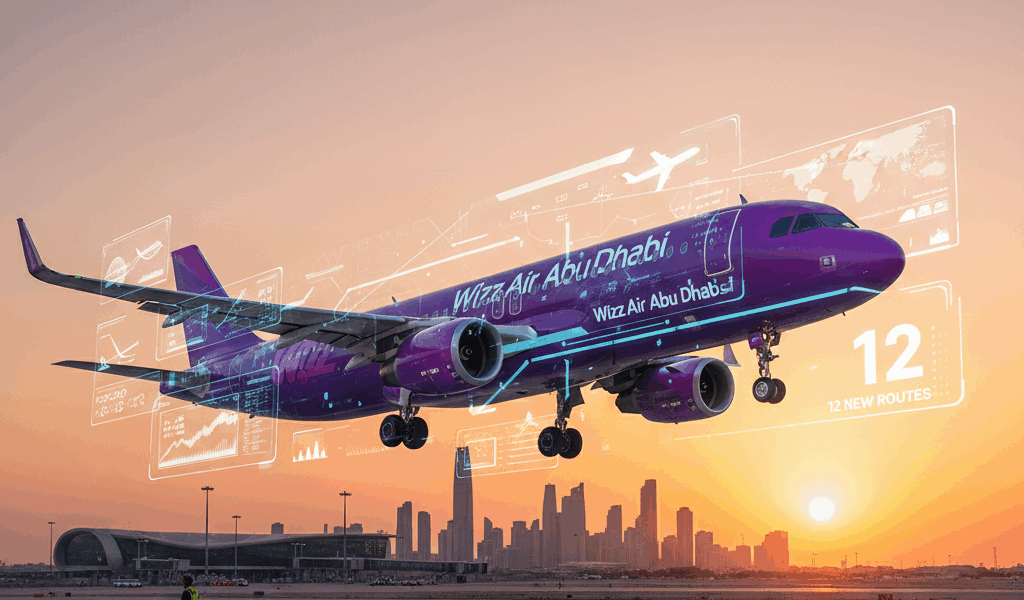
Wizz Air announced plans to launch service to 12 new destinations from its Abu Dhabi hub, expanding the ultra-low-cost carrier’s Middle East presence against legacy competitors Emirates and Etihad. The expansion marks a significant milestone in the Hungarian carrier’s strategy to establish Abu Dhabi as a gateway connecting Europe, Asia, and Africa.
New routes target secondary European cities and South Asian markets underserved by traditional carriers. The move reflects Wizz Air’s confidence that price-sensitive demand exists for no-frills service in a region traditionally dominated by full-service carriers.
Route Network Expansion Details
The 12 new routes span multiple continents, focusing on underserved city pairs where Wizz Air can stimulate demand through aggressive pricing. European additions include connections to secondary Italian, Greek, and Eastern European destinations that lack direct service from Gulf carriers.
South Asian routes represent a major focus, with multiple Indian cities targeted alongside Pakistani and Bangladeshi destinations. These markets feature large expatriate populations in the UAE combined with substantial visiting friends and relatives (VFR) traffic that responds well to low fares.
Central Asian routes to Kazakhstan and Uzbekistan round out the expansion, tapping into growing business and tourism flows between the Gulf and former Soviet states. These markets present less competition and strong growth potential.
Competition with Gulf Carriers
The expansion puts Wizz Air directly against Emirates and Etihad, though the ultra-low-cost model targets a distinctly different customer segment. While legacy Gulf carriers offer premium service with included meals, baggage, and extensive connectivity, Wizz Air’s unbundled model attracts price-conscious travelers willing to forgo frills.
Emirates and Etihad have largely ignored the ULCC segment, focusing instead on premium long-haul markets and connecting traffic. This strategic gap created an opening for Wizz Air and fellow low-cost carriers Air Arabia and flydubai.
Industry analysts note the Gulf market can support multiple models, given the region’s geographic position and diverse traffic flows. Price-sensitive segments including migrant workers, students, and budget tourists represent substantial demand that traditional carriers have not prioritized.
The Ultra-Low-Cost Model in the Middle East
Wizz Air’s ULCC model faces unique challenges in the Middle East market. Passenger expectations often exceed bare-bones service levels, particularly on routes with significant business travel or premium leisure demand.
The carrier has adapted its model for the region, offering enhanced baggage allowances on certain routes and maintaining service standards that address local preferences. However, the core unbundled pricing philosophy remains intact, with passengers paying only for services they use.
Early load factors suggest price-sensitive demand exists for the stripped-down product. Routes targeting expatriate traffic and VFR markets have performed particularly well, with load factors exceeding 85% on established services.
Ancillary revenue represents a crucial component of the business model, with Wizz Air generating significant income from seat selection, baggage, onboard food and beverage sales, and ancillary products. The airline’s digital platform enables efficient upselling throughout the booking journey.
Abu Dhabi as an Aviation Hub
Abu Dhabi’s investment in aviation infrastructure supports Wizz Air’s expansion ambitions. The opening of the new Midfield Terminal at Abu Dhabi International Airport provides modern facilities capable of handling growth.
The emirate actively courts airline partners through competitive airport charges and incentive programs that reduce the financial risk of new route launches. Abu Dhabi’s sovereign wealth fund owns 49% of Wizz Air Abu Dhabi, aligning interests between the carrier and its host city.
Geographic positioning gives Abu Dhabi advantages for connecting traffic between Europe, Asia, and Africa. The airport sits within eight hours of two-thirds of the world’s population, creating substantial connecting opportunities for network development.
Competition with neighboring Dubai remains a factor, though the markets increasingly differentiate. Dubai focuses on premium long-haul service through Emirates while Abu Dhabi develops a more diversified carrier portfolio including Etihad, Wizz Air, and Air Arabia Abu Dhabi.
Fleet Deployment and Aircraft Strategy
The expansion utilizes Airbus A321neo aircraft offering maximum range efficiency on routes exceeding 3,000 nautical miles. Wizz Abu Dhabi will operate 15 aircraft by year-end, up from 8 currently deployed.
The A321neo’s extended range capability proves essential for the Abu Dhabi network, enabling efficient service to European destinations that would strain older narrowbody types. Single-aisle operating economics keep costs low while range performance opens markets previously requiring widebody aircraft.
Future fleet growth could include the A321XLR, an extra-long-range variant that would further extend Wizz Air’s network reach from Abu Dhabi. This aircraft could potentially open routes to Southeast Asia and additional European destinations currently beyond A321neo range.
Fleet commonality with Wizz Air’s broader European operation provides flexibility, enabling aircraft and crew redeployment between markets as demand patterns shift seasonally.
Passenger Forecasts and Financial Outlook
Wizz Air projects carrying 4 million passengers through Abu Dhabi in the coming year, representing approximately 50% growth over current levels. The 12 new routes are expected to contribute substantially to this target.
Revenue per available seat kilometer (RASK) in the Middle East operation tracks slightly below European levels but benefits from lower operating costs at Abu Dhabi Airport. Unit economics remain positive, supporting continued investment.
Profitability at Wizz Air Abu Dhabi has improved as the operation scales. The joint venture structure with Abu Dhabi’s sovereign fund shares both risk and reward, providing a stable financial foundation for growth.
Long-term forecasts project Wizz Air Abu Dhabi growing to 25-30 aircraft, serving 50+ destinations from its Gulf base. This would establish the carrier as a significant player in regional aviation while maintaining its ultra-low-cost positioning.
Strategic Implications
The expansion demonstrates Wizz Air’s commitment to geographic diversification beyond its European base. Middle East operations provide revenue streams uncorrelated with European demand cycles while accessing high-growth markets.
Success in Abu Dhabi could inform similar partnerships in other regions, with Wizz Air previously exploring opportunities in markets from Saudi Arabia to Southeast Asia. The ULCC model’s adaptability to diverse markets has been proven.
For Abu Dhabi, Wizz Air’s growth supports the emirate’s aviation strategy of developing a diverse carrier ecosystem rather than relying solely on its national carrier Etihad. This approach provides resilience and captures demand segments that full-service carriers may not efficiently serve.




Stay in the loop
Get the latest aerodata updates delivered to your inbox.