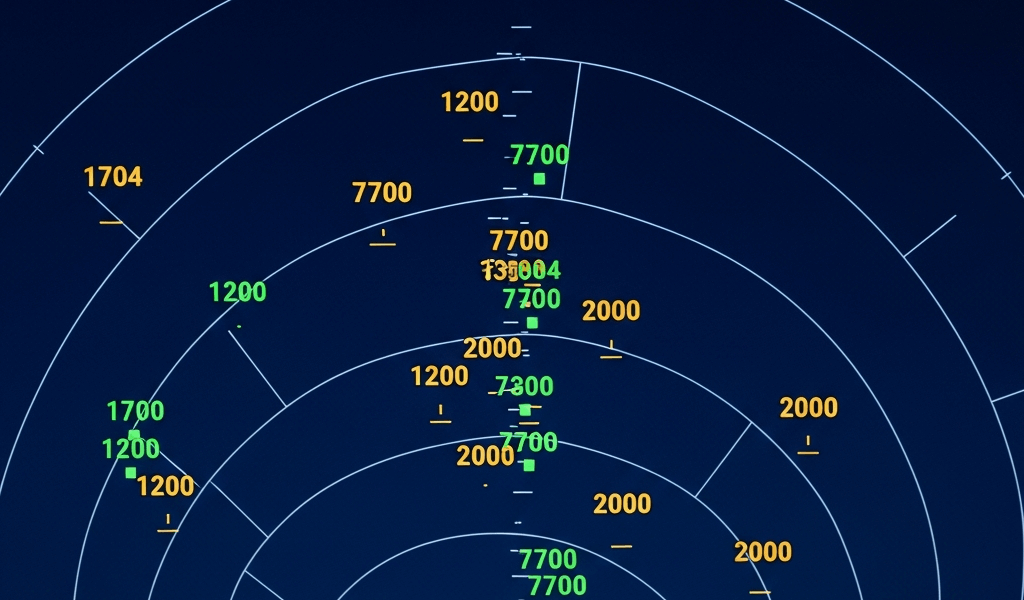
What You Actually See on a Flight Tracker
Flight tracking has gotten complicated with all the unexplained data flying around. I spent three months scrolling through FlightAware and ADS-B Exchange before I understood that those four-digit numbers actually meant something. Most of them are forgettable — 1200, 2541, nothing worth a second look. Then one Tuesday evening, a regional turboprop somewhere over Iowa suddenly flashed 7700 on my screen. My stomach dropped. I spent the next twenty-something minutes hammering the refresh button like a maniac until that flight touched down safely in Des Moines.
That’s honestly the moment most people stumble into squawk codes — and why they immediately cause confusion. The codes sit right there in plain sight on Flightradar24, RadarBox, ADS-B Exchange. Nobody explains what they mean in language that actually connects to the numbers you’re staring at.
Here’s the basic reality: every aircraft broadcasts a four-digit squawk code at all times. Air traffic control assigns it, or the pilot defaults to a standard number during routine VFR flight. Most of the time, these codes are completely mundane. Not random. Not broken. Just the system keeping track of who’s who up there.
The problem kicks in when something unusual pops up — a code that changes mid-flight, or something like 7600 or 7500 replacing what was there before. The app does nothing to explain it. So you’re left Googling at midnight, heart doing things it shouldn’t, wondering if you just watched an aviation emergency unfold in real time on a $12/month subscription app.
How the Squawk System Actually Works
Squawk codes run on octal math. Each digit goes from 0 to 7 — not 0 to 9 — which gives the whole system exactly 4,096 possible combinations. That ceiling matters. Radar systems need to tell one aircraft from another, and in dense airspace like the Northeast corridor, you need enough unique codes to go around without overlap.
IFR flying — Instrument Flight Rules, meaning you’re on a filed flight plan and actively talking to ATC — gets you a discrete code. ATC assigns it specifically to your aircraft. That code ties directly to your callsign, altitude data, and flight plan on their screen. Hand off to the next sector, you might get an entirely new code. Same plane, new digital identity for the next set of controllers.
VFR flying is different. Visual Flight Rules, typically smaller aircraft in decent weather, squawk 1200 by default in the United States. It tells ATC: I’m here, I’m fine, I’m not requesting radar services. Thousands of aircraft transmit 1200 simultaneously at any given moment. It’s the aviation equivalent of a generic nametag.
Mode A and Mode C are the technical layers underneath all of this — though, honestly, you don’t need to memorize them. Mode A carries the squawk code itself. Mode C adds altitude. Together, they’re what ADS-B ground receivers pick up and push to flight tracker websites. That blip on Flightradar24 is the live output of that transmission, bouncing off receivers potentially within a few miles of wherever the aircraft happens to be.
That’s what makes squawk codes endearing to us aviation nerds — and also endlessly misunderstood. Once ATC assigns a code and the pilot dials it into the transponder, it just sits there quietly doing its job. No alerts. No push notifications. Four digits, background noise, until something changes.
The Four Codes That Mean Something Is Wrong
Probably should have opened with this section, honestly. These are the ones that send flight tracker hobbyists into a full spiral.
7700 — General Emergency. This is the big one. Squawking 7700 means a pilot needs immediate attention from ATC — engine fire, hydraulic failure, medical emergency onboard, loss of cabin pressure, structural damage. The list goes on and it’s not pleasant reading. But here’s what most people miss: the majority of 7700 squawks don’t end in anything newsworthy. Pilots declare emergencies for fuel concerns, for mechanical issues that get handled mid-flight, for passenger medical situations that resolve before landing. I’ve personally tracked dozens of 7700 squawks on ADS-B Exchange. Most landed without incident and never once touched the news cycle.
7600 — Radio Failure. The transponder works fine. The radio doesn’t. The pilot squawks 7600 essentially to say: I’m here, I can see you, but I can’t talk to you. ATC handles it visually or — yes, this is real — using light gun signals from the tower. It resolves on the ground with avionics troubleshooting most of the time. Less dramatic than 7700, but worth knowing.
7500 — Unlawful Interference. Hijacking, in plain language. This code almost never gets squawked — I mean almost never in any era of modern commercial aviation. When it does appear, ATC immediately notifies military authorities and law enforcement, and the situation escalates fast on the ground. The misconception that pilots accidentally dial 7500 and trigger chaos is basically false. ATC would radio immediately to confirm. Don’t make my mistake of treating every unusual squawk like it’s this one.
7777 — Military Intercept Operations. This one gets misread constantly, and I’m apparently wired to panic about it because seeing it on FlightAware sent me down a two-hour research spiral the first time. 7777 appears when military aircraft are conducting operations or escorting a civilian aircraft. It’s not a distress signal. It means military involvement — usually routine training or security operations that nobody on the ground has any reason to worry about.
Why Squawk Codes Sometimes Look Wrong on Trackers
ADS-B receivers capture live transponder data and push it straight to flight tracker websites. Real time. No filter. The upside is you’re seeing exactly what the aircraft is broadcasting right now. The downside is you’re also seeing every glitch, handoff, and transition that happens during a normal flight.
A code change mid-flight? Normal — sector handoff. A flight briefly showing 1200 during a transition between ATC facilities? Normal. A code that vanishes for a few seconds? Also normal, usually just a gap in receiver coverage. Flight trackers pull from hundreds of individual ADS-B receivers across overlapping networks, so momentary dropouts happen constantly.
From a user perspective, though, a code that looks wrong feels like a bug. Or evidence of something serious. That’s the gap between what the system is doing and what it looks like it’s doing. — at least if you haven’t spent time learning the underlying mechanics.
What to Do If You See an Emergency Squawk
Watch. Don’t speculate publicly. ADS-B Exchange flags 7700 squawks visually with on-screen alerts, and you won’t be the only set of eyes on it. If something genuinely catastrophic develops, news outlets pick it up within minutes — sometimes faster than the tracker updates.
Emergency squawks resolve quietly the vast majority of the time. The aircraft lands. The crew handles whatever the problem was. Life moves on. You’ll never hear about it because it wasn’t a disaster — and that’s actually the point of the whole system. Early communication, early response, routine resolution.
So, without further ado, the next time a strange four-digit number catches your eye on a flight tracker, you’ll know exactly what you’re looking at.




Stay in the loop
Get the latest aerodata updates delivered to your inbox.