Weather’s Pervasive Impact on Aviation
Snow, ice, and freezing precipitation hit both ground operations and flight. De-icing before departure is mandatory and time-consuming. Runways need plowing and treatment. Ice accumulation in flight degrades performance, though modern aircraft have anti-ice and de-ice systems that handle it well. The ground side is usually the bigger problem.
Strong crosswinds prevent landings. Headwinds stretch flight times and burn extra fuel. The jet stream position shapes routing for every transcontinental and transoceanic flight. And wind shear — sudden changes in wind speed or direction — creates genuine hazards during takeoff and landing. I’ve seen wind shear alerts close an approach path in seconds.
Clear air turbulence shows up without warning, typically near jet streams and over mountains. Convective turbulence rides with thunderstorms. Mountain wave turbulence forms downwind of terrain. It rarely damages the aircraft itself, but it injures passengers and crew. Fasten your seatbelt when the sign comes on. Trust me on this.
Aviation gets its own specialized weather products, separate from what you see on TV:
Airport-specific forecasts covering ceiling, visibility, wind, and significant weather for 24-30 hours. They use a coded format that’s standardized internationally. Takes some practice to read fluently.
Broader regional forecasts covering larger areas, including expected turbulence, icing levels, and significant weather systems moving through.
Real-time reports from pilots actually flying through conditions. This is ground truth — what’s actually happening at altitude right now, including turbulence, icing, and cloud tops. I always valued PIREPs more than model output because they’re real, not predicted.
NEXRAD radar shows precipitation intensity and movement in near real-time. Satellite imagery reveals cloud cover, fog formation, and large-scale patterns. Together they give meteorologists a solid picture of what’s happening now.
Computer models forecast weather days ahead, though accuracy drops off with time. Ensemble models run multiple scenarios to quantify uncertainty. Smart forecasters know which models to trust for which phenomena.
Airlines and ATC track weather’s damage through several metrics:
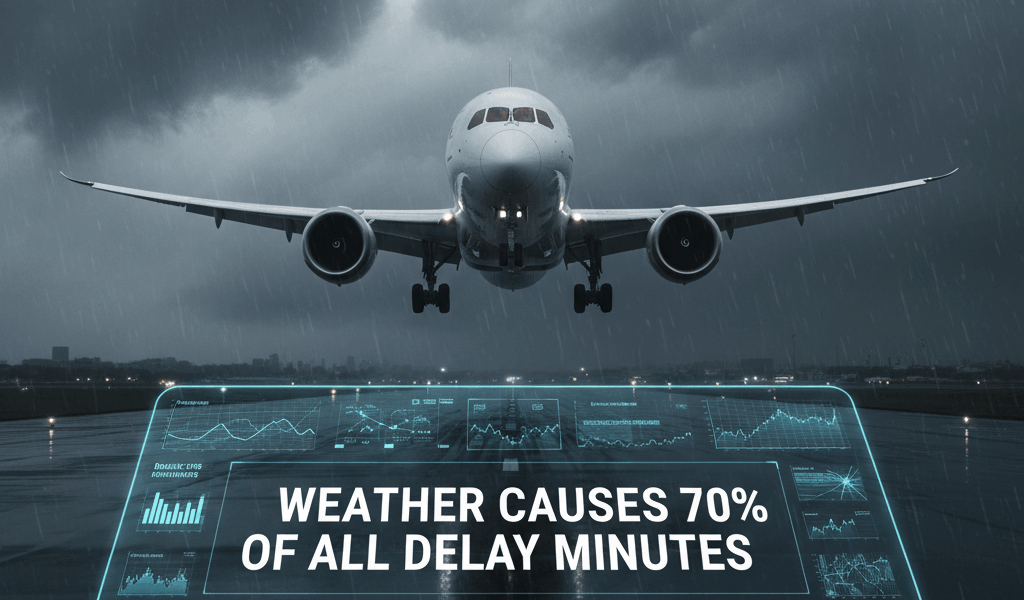
Total delay minutes blamed on weather. It typically accounts for 70% or more of all delay minutes systemwide. That number always surprises people. Seventy percent. Weather dominates everything else.
The percentage of flights that can’t land where they intended, usually because weather dropped below minimums. Diversions are expensive for the airline and miserable for passengers.
Flights killed by weather, either at origin or destination. Major winter storms and hurricanes can push cancellation rates above 50% at affected airports. I’ve seen entire hub operations collapse in a single afternoon.
Additional fuel burned due to weather-related rerouting, holding, and diversions. Strong headwinds on certain routes can add thousands of dollars in unplanned fuel costs per flight. Multiply that across a fleet and a season, and the numbers get very large very fast.
ATC uses several tools to manage the chaos when weather hits:
When weather reduces an airport’s arrival capacity, departures to that airport get held on the ground rather than launched into the air. The logic is solid — it’s far cheaper and smarter to delay a plane at the gate than to burn fuel circling in a holding pattern.
A complete halt to departures headed for an affected airport. These happen during severe weather that’s expected to pass relatively quickly. Painful but necessary.
Increased spacing requirements that effectively throttle down traffic volume through affected airspace. Fewer planes per hour, more orderly flow.
Pre-coordinated alternate routes that dodge weather-affected airspace while keeping traffic moving. These get published and updated as weather evolves throughout the day.
Airlines don’t leave weather to chance. They build serious capabilities around it:
Many airlines employ their own meteorologists specializing in aviation weather. They produce customized forecasts tailored to flight planning and daily operations. The good ones are worth their weight in jet fuel.
Specialized tools help dispatchers evaluate weather risk for individual flights, recommend fuel loads that account for potential deviations, and identify alternate airports in case the primary destination goes below minimums.
Flight crews get pre-flight briefings covering en route conditions, destination forecasts, and any significant hazards. The quality of these briefings varies, but the best ones give pilots real situational awareness before they leave the gate.
Weather’s financial toll on the aviation industry is staggering:
The weather picture is likely getting worse, not better:
Weather impact analysis is essential for anyone in aviation operations. From planning a single flight to managing system-wide traffic flow, understanding how weather affects the system enables better decisions at every level. Despite all the technology we’ve built, weather stays fundamentally unpredictable beyond a few days. That means preparation and flexibility aren’t optional — they’re survival skills for keeping air travel running when the sky doesn’t cooperate.



Stay in the loop
Get the latest aerodata updates delivered to your inbox.