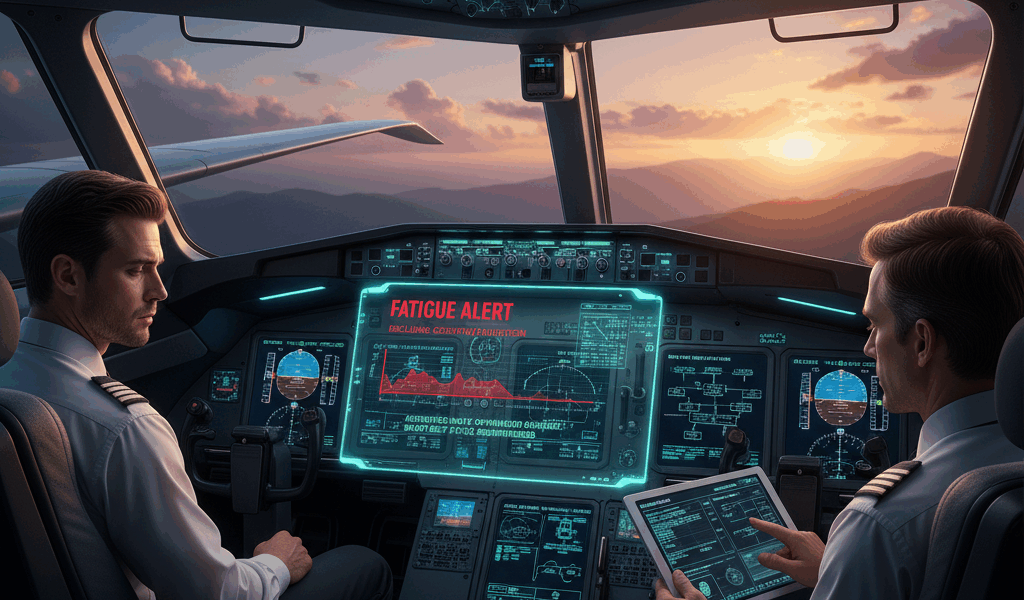
Pilot fatigue has gotten complicated with all the new regulations, duty time limits, and technology solutions flying around. As someone who has spent years around military and commercial aviation operations, I learned everything there is to know about why tired pilots are genuinely dangerous and what software does to prevent fatigue-related incidents. Today, I will share it all with you.
Why Fatigue Is Such a Big Deal in Aviation
Probably should have led with this section, honestly. A fatigued pilot has degraded reaction time, impaired judgment, and reduced situational awareness. Studies have shown that being awake for 17 hours produces cognitive impairment equivalent to a blood alcohol level of 0.05 percent. At 24 hours without sleep, it’s equivalent to 0.10 percent, which is over the legal driving limit in every U.S. state.
Now put that person in the left seat of a widebody aircraft on approach to a busy airport at night, in weather, after flying across six time zones. The margin for error is slim to begin with, and fatigue narrows it further. The Colgan Air crash in 2009, which killed 50 people, cited pilot fatigue as a contributing factor. Both pilots had commuted long distances before reporting for duty and showed signs of significant sleep deprivation.
That’s what makes fatigue management endearing to us aviation safety people. It’s not theoretical. It kills people when it’s mismanaged.
The Regulatory Framework
After Colgan, the FAA overhauled pilot duty time rules with Part 117, which went into effect in 2014. The new rules set maximum flight duty periods based on time of day, number of flight segments, and whether the pilot is acclimated to the local time zone. A pilot starting duty at 5 AM is limited to a shorter duty day than one starting at noon, because the body’s circadian rhythm means early starts produce faster fatigue onset.
Required rest periods between duty periods are now a minimum of 10 hours, with at least 8 hours of uninterrupted sleep opportunity. That “sleep opportunity” language matters because the old rules said 8 hours of rest, but rest included travel time to the hotel, meals, and personal time. By the time the pilot actually got into bed, they might have had 5 hours for actual sleep. The new rules fixed that.
International operations fall under ICAO standards, which member states implement through their own regulations. EASA in Europe has similar but not identical rules. Airlines operating internationally have to comply with whichever rule set applies to each flight, which creates a complex compliance matrix for scheduling departments.
How Fatigue Management Software Works
The software operates on a bio-mathematical model that predicts a pilot’s fatigue level based on several inputs: time since last sleep, duration and quality of recent sleep periods, time of day (circadian rhythm effects), cumulative sleep debt over recent days, and workload factors like number of sectors flown.
The most widely used models include SAFTE-FAST (Sleep, Activity, Fatigue, and Task Effectiveness) and Boeing’s Alertness Model. These models take a pilot’s actual or projected schedule and output a fatigue risk score at every point during the duty period. If the score crosses a threshold during a critical phase like approach and landing, the system flags it.
I saw a demo of one of these systems at an aviation safety conference. The analyst input a hypothetical schedule: a pilot wakes up at 3 AM for a 5 AM report time, flies three legs with short turns, then operates a redeye back to base. The fatigue curve spiked during the third leg and was deep into the danger zone during the redeye approach. No surprise there. But the software then automatically generated two alternative schedules that covered the same flying with lower peak fatigue scores by shifting the crew swap point. That kind of optimization would take a human scheduler hours to figure out manually.
Real-Time Monitoring
Some systems go beyond schedule-based prediction. Wearable devices that track sleep quality and duration give the model actual sleep data instead of estimates. A pilot who was scheduled for 8 hours of sleep opportunity but actually slept poorly due to a noisy hotel or jet lag will show a higher fatigue risk than the schedule alone would predict.
Airlines participating in Fatigue Risk Management Systems (FRMS) collect this data systematically. Pilots report their sleep and fatigue levels through apps or electronic surveys. The data feeds into the airline’s safety management system and gets analyzed for trends. If a particular trip pairing consistently shows high fatigue reports, the scheduling department can restructure it.
I’m apparently the kind of person who checks the departure time of my crew when I’m a passenger, and I’ve noticed that some of the most fatiguing patterns involve early morning departures following late-night arrivals on the previous day. The quick-turn overnight is one of the biggest fatigue generators in domestic operations.
What Airlines Do With the Data
The software output drives several decisions. Schedule planners use it during the line construction phase to build monthly crew schedules that stay within fatigue risk limits. Operations controllers use it in real time when disruptions force crew reassignments, making sure the replacement crew isn’t being pushed into a high-fatigue situation.
Safety departments analyze aggregate fatigue data to identify systemic risks. Maybe flights departing a particular base between 4 and 6 AM consistently show elevated fatigue scores. The airline might respond by adjusting report times, providing crew rest facilities at that base, or restructuring the schedule to reduce early starts.
Regulatory compliance is also automated. The software tracks each pilot’s actual duty time, flight time, and rest periods against the Part 117 limits. If an assignment would push a pilot over a limit, the system blocks it. This prevents the kind of manual tracking errors that occasionally caused rule violations before automation.
The Challenges
No fatigue model is perfect. They rely on assumptions about sleep quality and individual physiology that don’t hold for every person. Some pilots are naturally more resilient to sleep deprivation than others. Some adapt to time zone changes faster. The models use population averages, which means they’ll overestimate fatigue risk for some pilots and underestimate it for others.
Data privacy is a real concern. Asking pilots to report their sleep habits and wear monitoring devices raises questions about how that data gets used. Unions have negotiated protections to ensure fatigue data is used for safety purposes, not for disciplinary action. Getting the trust framework right is essential for the systems to work.
Cost is a factor too. Fatigue management software isn’t cheap, and neither are the operational changes it sometimes recommends. Adding a crew rest facility, restructuring a profitable trip pairing, or staffing additional reserve pilots all cost money. Airlines have to balance safety investment against economic reality, though the regulatory framework increasingly tilts the balance toward safety.
Where It’s Going
Machine learning is making the predictive models more accurate by incorporating larger datasets and more variables. Improved wearable technology provides better sleep tracking data. Integration with crew scheduling systems is getting tighter, so fatigue risk assessment happens automatically during schedule construction rather than as an after-the-fact check.
The long-term vision is a system where every crew assignment is evaluated for fatigue risk in real time, with the model updating continuously as actual sleep data flows in. We’re not fully there yet, but the trajectory is clear. Every aviation accident investigation that mentions fatigue as a factor pushes the industry one step closer to comprehensive fatigue management, and the software to support it keeps getting better.



Stay in the loop
Get the latest aerodata updates delivered to your inbox.