Thermoplastic composites have gotten complicated with all the new fiber technologies and manufacturing processes flying around. As someone who has followed aerospace materials for years, I learned everything there is to know about why this particular class of materials is changing how aircraft get built. Today, I will share it all with you.
First, What Makes a Thermoplastic Different
Probably should have led with this section, honestly. A thermoplastic is a polymer that softens when you heat it and hardens when you cool it. You can repeat that cycle over and over. Polyethylene, polypropylene, nylon, PEEK — these are all thermoplastics. Contrast that with thermosets like epoxy, which cure once and stay rigid permanently. You can’t reheat an epoxy part and reshape it. With a thermoplastic, you can.
That reprocessability is the whole reason thermoplastic composites exist as a category. If you embed reinforcing fibers in a thermoplastic matrix instead of a thermoset, you get a composite material that’s strong, stiff, and lightweight like a traditional carbon fiber composite, but with the added benefit of being weldable, reformable, and recyclable.
The Fibers That Do the Heavy Lifting
The matrix is only half the story. The fibers provide the structural performance. Three types dominate:
Glass fibers are the workhorse. Cheap, widely available, and strong enough for most structural applications. Glass fiber reinforced thermoplastics show up in automotive panels, consumer products, and lower-stressed aerospace parts. I’ve held glass-reinforced nylon brackets that weighed almost nothing but could support loads that would bend a steel bracket of the same size.
Carbon fibers are the premium option. They’re stiffer and lighter than glass but cost significantly more. In aerospace, where every pound matters, carbon fiber reinforced thermoplastics are increasingly replacing both metallic parts and traditional thermoset composites. The combination of carbon fiber with a PEEK or PEKK matrix produces parts that can handle the temperatures and loads found in structural aircraft components.
Aramid fibers, best known by the brand name Kevlar, offer exceptional impact resistance. They absorb energy rather than shattering, which makes them ideal for ballistic protection and crash-resistant structures. Less common in mainstream aerospace manufacturing because they’re difficult to machine and more expensive than glass, but they fill specific niches where nothing else performs as well.
Why Aerospace Cares About This
That’s what makes thermoplastic composites endearing to us aerospace watchers. They solve problems that thermoset composites don’t.
Traditional carbon fiber epoxy parts require autoclave curing, which means loading the part into a giant pressure cooker and baking it for hours. The autoclaves are enormous, expensive to operate, and create a production bottleneck. Thermoplastic composites can often be formed using faster processes like stamp forming or automated fiber placement with in-situ consolidation, which means no autoclave. The cycle times drop from hours to minutes in some cases.
Weldability is another big advantage. You can join two thermoplastic composite parts using resistance welding, ultrasonic welding, or induction welding. No fasteners, no adhesive, no drilling holes that create stress concentrations. Airbus uses thermoplastic welded joints on the A350 fuselage clips, replacing thousands of individual fasteners. That’s real weight savings and real labor savings on a production line running at rate.
And then there’s recyclability. The aerospace industry generates substantial composite waste, both in manufacturing (offcuts, rejected parts) and at end-of-life. Thermoset composites are extremely difficult to recycle. Thermoplastics can theoretically be ground up and reprocessed. In practice, the recycling infrastructure for high-performance thermoplastic composites is still developing, but the material properties make it technically feasible in a way that thermosets simply aren’t.
How These Parts Get Made
Injection molding works for short-fiber reinforced parts. The thermoplastic pellets, already loaded with chopped fibers, get melted and injected into a mold. It’s fast, repeatable, and good for producing complex shapes in high volumes. Most of the thermoplastic composite parts in your car were made this way.
Compression molding handles larger parts and continuous fiber reinforcements. Pre-consolidated sheets of fiber-reinforced thermoplastic get heated, placed into a press, and formed under pressure. Cycle times are measured in minutes rather than the hours required for autoclave-cured thermosets.
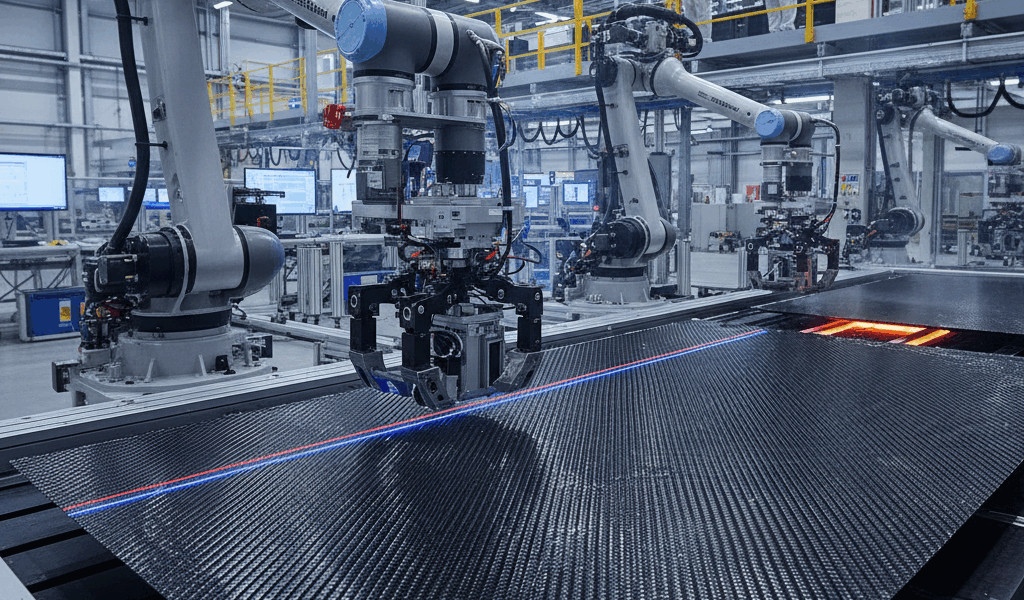
Automated fiber placement is where things get interesting for large aerospace structures. A robot lays down continuous tapes of fiber-reinforced thermoplastic onto a tool surface, heating each layer as it’s placed to bond it to the layers below. This in-situ consolidation eliminates the need for a separate curing step. The part comes off the tool ready to use.
Filament winding wraps continuous fiber tow around a rotating mandrel to produce cylindrical or tubular parts. Pressure vessels, rocket motor cases, and drive shafts are common applications. The thermoplastic matrix version offers better damage tolerance than thermoset equivalents.
Where You’ll Find Them
In aerospace, thermoplastic composites are in wing leading edges, fuselage clips, brackets, floor panels, and increasingly in larger primary structures. The Airbus A350 uses a significant amount of thermoplastic composite components. Gulfstream, Fokker (now GKN Aerospace), and Spirit AeroSystems have all invested heavily in thermoplastic composite production capability.
Automotive is a huge growth area. BMW used carbon fiber reinforced thermoplastics in the i3 and i8. Underbody shields, structural crossmembers, and seat frames are all candidates. The automotive industry’s appetite for fast cycle times and high production rates plays to thermoplastics’ strengths.
I’m apparently the kind of person who picks up a carbon fiber panel and tries to flex it to feel the stiffness, which tells you almost nothing useful but feels impressive. The real performance data comes from testing, and the test results for thermoplastic composites in impact, fatigue, and environmental exposure consistently match or exceed thermoset equivalents.
The Challenges That Remain
High-performance thermoplastic resins like PEEK are expensive. Significantly more expensive than epoxy. The raw material cost is a barrier to adoption, especially for price-sensitive applications outside aerospace. The processing temperatures are also higher, typically 350 to 400 degrees Celsius for PEEK, which demands tooling and equipment that can handle those temperatures consistently.
Thermal expansion mismatches between the polymer matrix and the reinforcing fibers create internal stresses during cooling. Managing those stresses through process control is critical. Get it wrong and you end up with residual stresses that reduce the part’s performance under load.
But the trajectory is clear. Every year, more aerospace programs specify thermoplastic composites for components that were previously metal or thermoset. The manufacturing processes are maturing, the material databases are growing, and the supply chain is scaling up. For aviation, this is one of the materials shifts that will define the next generation of aircraft.




Stay in the loop
Get the latest aerodata updates delivered to your inbox.