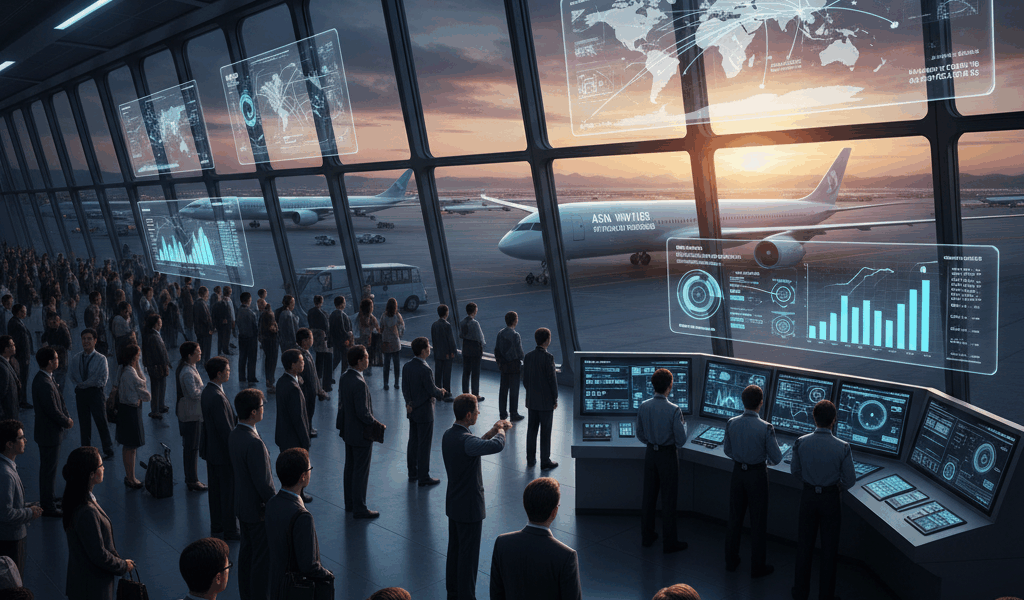
Asia-Pacific has emerged as commercial aviation’s dominant growth region, now accounting for over 40% of global passenger traffic. The numbers reveal a fundamental rebalancing of the aviation industry toward the East, with implications for manufacturers, airports, and the entire aerospace supply chain.
Traffic Growth Trajectory
Chinese domestic aviation has grown at compound annual rates exceeding 10% over the past two decades. The Civil Aviation Administration of China processed over 700 million domestic passengers in 2024, approaching U.S. domestic traffic levels despite starting from a much smaller base. By 2030, Chinese domestic traffic is projected to exceed any other single market globally.
Indian aviation shows even more dramatic growth rates. Domestic traffic has tripled since 2014, with IndiGo alone now operating 350+ aircraft. India added 50 million annual passengers in 2024, growth that would represent a major carrier’s entire operation in mature markets. The country is projected to become the third-largest aviation market by 2027.
Fleet Orders and Deliveries
Asia-Pacific carriers hold approximately 45% of the global aircraft order backlog. Chinese carriers have ordered over 1,000 aircraft from Airbus and Boeing, with additional orders for domestically-manufactured C919 narrowbodies. Indian carriers have placed similarly massive orders, with IndiGo alone holding commitments for 1,000+ aircraft.
The regional distribution of new aircraft deliveries has shifted dramatically. In 2010, North American and European carriers received over 60% of new aircraft. By 2024, Asia-Pacific carriers received approximately 45% of deliveries. Manufacturing economics now depend heavily on Asian demand.
New Airports and Infrastructure
Asian airport construction proceeds at unprecedented scale. China alone has built over 100 new airports since 2010, with Beijing Daxing representing the world’s largest airport terminal. India plans 100 new airports by 2030 under the UDAN regional connectivity scheme. Vietnam, Indonesia, and the Philippines all have major airport expansion programs underway.
This infrastructure investment removes capacity constraints that limited growth in other regions. While European and North American hubs struggle with slot limitations and runway capacity, Asian airports provide expansion room for decades of growth.
Airline Evolution
Asian carriers have evolved from regional operators to global competitors. The Gulf carriers transformed long-haul travel economics by creating hub competition. Singapore Airlines and Cathay Pacific maintain premium positioning in intercontinental markets. Korean Air and Japan Airlines continue expanding transpacific presence.
Low-cost carriers have revolutionized intra-Asian travel. AirAsia operates over 250 aircraft across multiple national subsidiaries. Lion Air and its affiliates operate 400+ aircraft from Indonesia across Southeast Asia. These carriers have made air travel accessible to middle-class populations across the region.
Challenges Remaining
Growth brings complications. Asian airspace congestion creates endemic delays in major corridors. The Singapore-Hong Kong route, flying time of 3.5 hours, regularly experiences delays exceeding 30 minutes due to traffic management. Air traffic control infrastructure investment lags aircraft ordering.
Pilot supply constraints have emerged as growth limiters. Asian carriers have recruited pilots globally, creating shortages in traditional source regions. Training capacity is expanding but cannot immediately match fleet growth. Some carriers have deferred deliveries due to crew availability.
Geopolitical Complexity
Asian aviation operates in a complex geopolitical environment. Territorial disputes affect routing over South China Sea airspace. Political tensions can close airspace without warning, as occurred with Myanmar restrictions. Airlines must navigate diplomatic sensitivities that rarely affect operations in more stable regions.
Trade conflicts between major powers affect aircraft procurement. Chinese carriers face restrictions on U.S.-manufactured engine components. Reciprocal actions could affect Airbus deliveries using U.S. technology. The intersection of aviation commerce and international relations creates uncertainty for long-term planning.
The Future Balance
Demographic and economic fundamentals suggest Asian aviation growth will continue. Over 4 billion people live in the Asia-Pacific region, with rapidly growing middle classes increasingly able to afford air travel. Trip rates remain far below Western levels, suggesting enormous untapped demand.
By 2040, projections suggest Asia-Pacific will account for over 50% of global aviation activity. The industry’s center of gravity continues shifting eastward. Manufacturers, suppliers, and service providers that fail to establish strong Asian positions risk marginalization in aviation’s future.
Subscribe for Updates
Get the latest articles delivered to your inbox.
We respect your privacy. Unsubscribe anytime.