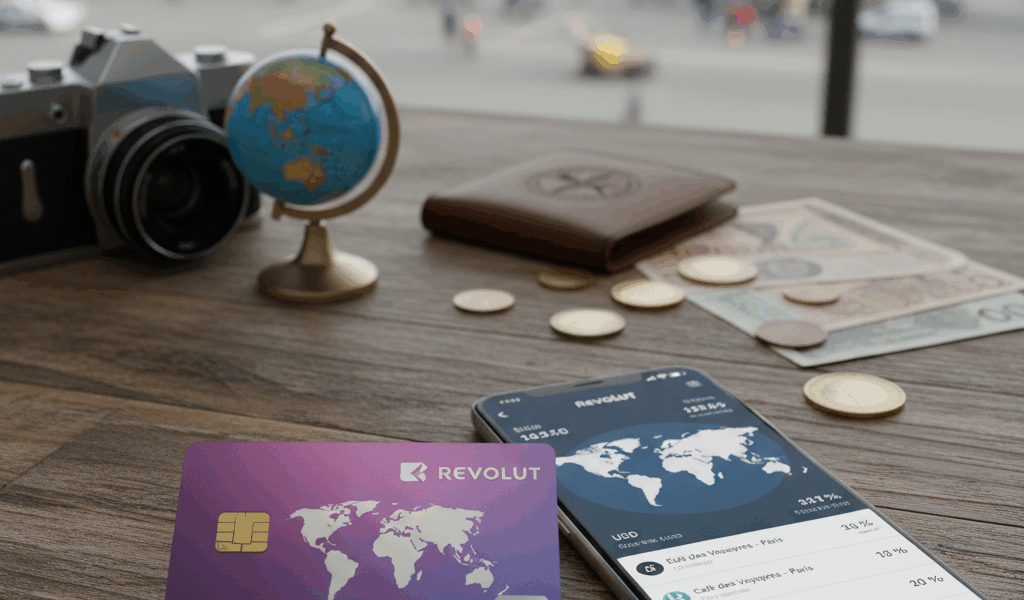
Managing money while traveling internationally has gotten complicated with all the neobank options and fintech apps flying around. As someone who has used multiple banking apps across different countries, I learned everything there is to know about how Revolut stacks up for travelers. Today, I will share it all with you.

Here’s the short version: traditional banks charge you twice when you spend money abroad. They give you a bad exchange rate and then tack on a foreign transaction fee on top of it. Revolut eliminates both of those problems, and that’s the main reason travelers use it. But there’s a lot more to it than that.
Multi-Currency Accounts
Revolut lets you hold 30-plus currencies in one account. You load money in your home currency, then convert it to whatever you need. The exchange rates use the interbank rate, which is the rate banks charge each other. It’s significantly better than the tourist rate you’d get at an airport exchange counter or from your traditional bank.
I used this on a trip through Europe where I hit four countries in ten days. Instead of dealing with separate currency conversions at each border, I just swapped pounds to euros, then euros to Czech koruna, all in the app while sitting on a train. No lines, no bad rates, no handling cash at sketchy exchange booths. Probably should have led with this section, honestly, because the multi-currency feature alone justifies the app for frequent travelers.
ATM Withdrawals
Free ATM withdrawals up to a monthly limit, depending on your plan:
- Standard Plan: around 200 pounds or equivalent
- Premium Plan: around 400 pounds or equivalent
- Metal Plan: around 600 pounds or equivalent
Beyond those limits, a small fee kicks in. For most trips, the standard limit covers what you need. I rarely withdraw more than a couple hundred in cash during a trip anyway since card acceptance is near-universal now in most countries. The exception is Japan, where cash is still king in smaller shops and restaurants. I blew through my ATM limit there in about four days.
No Foreign Transaction Fees on Card Payments
This is the feature that saves the most money over the course of a trip. Every restaurant bill, every museum ticket, every grocery run. Zero foreign transaction fees. My old bank charged 2.9% on every international purchase. On a two-week trip where I put maybe 3,000 dollars on the card, that’s almost 90 bucks in fees I’d never get back. Revolut charges nothing.
Real-Time Notifications and Security
Every transaction triggers an instant push notification with the amount and the merchant name. It sounds minor until you’re in a country where card skimming is common and you want to know immediately if something charges your card that shouldn’t.
The security features go further than most banks. You can freeze your card instantly in the app if you think something’s wrong. Unfreeze it just as fast when you find it in your other jacket pocket. There’s also disposable virtual card numbers for online purchases, which generates a fresh card number for each transaction. If a website gets breached, the card number they have is already dead.
I’m apparently paranoid enough about card security while traveling that I use a different virtual card number for every online booking. It adds about 15 seconds per transaction and eliminates an entire category of fraud risk.
Travel Insurance on Premium Plans
The higher-tier plans bundle travel insurance that covers medical expenses, flight delays, and lost luggage. Having insurance embedded in the same app where you manage your money simplifies the pre-trip checklist. One less thing to buy separately, one less policy to track.
Budgeting and Expense Tracking
The app categorizes every transaction automatically. Restaurants, transport, shopping, entertainment. At the end of a trip you can see exactly where the money went. I used this to compare spending across three trips to London and realized I was spending almost as much on Uber rides as on hotels, which changed how I planned my next visit. That kind of visibility is what makes Revolut endearing to us budget-conscious travelers.
Splitting Bills With Travel Companions
Traveling with friends or family means someone always ends up fronting costs. Revolut’s bill splitting feature lets you divide an expense and request payment from other Revolut users instantly. No more “I’ll Venmo you later” that turns into “I’ll Venmo you never.” The money transfers within the app are instant and free.
Lounge Access for Metal Users
The Metal plan includes complimentary airport lounge access. For anyone who’s spent a six-hour layover sitting on a terminal floor next to a power outlet, lounge access is a meaningful quality-of-life upgrade. Comfortable seating, food, drinks, Wi-Fi that actually works. Discounted guest access means you can bring a travel companion without paying full price.
Weekend Exchange Rate Markup
One thing to know: Revolut adds a small markup on currency exchanges during weekends because the forex markets are closed and rates can gap when they reopen Monday. The markup is typically 0.5 to 1 percent. If you know you’ll need foreign currency, converting on a weekday avoids this. It’s a minor detail but worth knowing if you’re converting large amounts.
Overall, Revolut does what it promises. It removes the friction and hidden costs from spending money in other countries. It’s not perfect. Customer support can be slow on the free plan, and some features are locked behind the paid tiers. But for the core use case of traveling internationally without getting nickeled and dimed on every transaction, it’s hard to beat.



Stay in the loop
Get the latest aerodata updates delivered to your inbox.