Today, I will share it all with you.
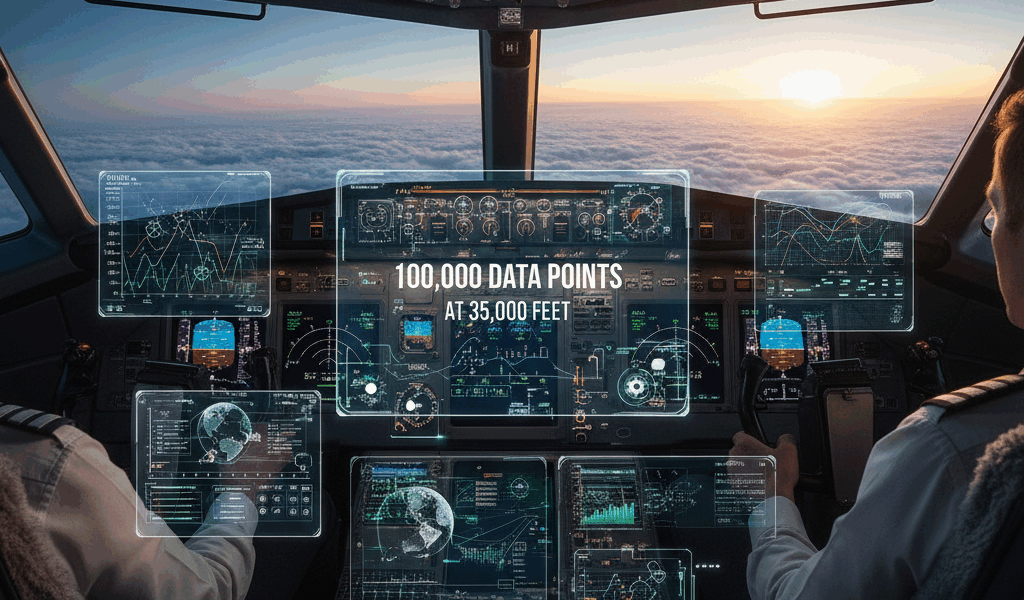
Here’s the thing most people miss: your average commercial jet is basically a flying sensor array. We’re talking roughly 100,000 data points generated every single flight hour. At cruise, that stream of information just never stops. Twenty years ago? None of this existed. Not at this scale, anyway.
What Gets Measured

The range of what gets tracked on a modern aircraft is honestly staggering when you start digging into the specifics. Engines alone account for over 15,000 parameters. Exhaust gas temperature at multiple turbine stages. Oil pressure and temperature. Vibration frequencies across the N1 and N2 spools. Fuel flow rates. Bleed air extraction levels. Every single one of those gets sampled multiple times per second. I remember the first time I saw a raw engine data dump — my eyes glazed over after the first thousand lines.
Flight control systems pile on another 20,000+ data points. We’re talking control surface positions measured to fractional degrees. Hydraulic pressures across primary and backup circuits. Autopilot mode states and calculated trajectories. Each data element gives you a window into how the aircraft is actually behaving versus how it should be behaving. That gap between the two is where the interesting stuff lives.
Then you’ve got environmental and structural sensors adding even more depth. External air temperature accurate to a tenth of a degree Celsius. Static and dynamic pressure measurements that feed into altitude and airspeed calculations. Strain gauges on wing spars recording load factors when you hit turbulence. Accelerometers spread throughout the fuselage mapping vibration patterns. It’s a lot.
From Tape to Real-Time
The shift from tape-based recording to real-time streaming is the single biggest change in how we handle flight data.
Old-school aircraft recorded everything on magnetic tape. You couldn’t touch that data until the plane landed and someone physically pulled the tape. Now? Modern aircraft beam operational data continuously over satellite links. Boeing’s Airplane Health Management system streams information in near real-time, letting ground monitoring centers track fleet health across the globe while planes are still in the air.
This connectivity flipped airline operations on its head. When an engine parameter goes sideways on a trans-Pacific flight, maintenance crews start prepping replacement parts before the aircraft even touches down. When a flight control actuator starts acting funny, engineers pull up the data remotely and either clear the aircraft to keep flying or order an inspection right then and there. No guessing. No waiting.
The Data Volume Challenge
Here’s a number that still blows my mind. A single Boeing 787 can spit out 500 gigabytes of data per flight. Run that across a major airline’s fleet — say 200+ widebody aircraft — and you’re looking at daily data production north of 100 terabytes. Storing, processing, and actually pulling useful insights from that volume requires infrastructure most people associate with big tech companies, not airlines.
But airlines have stepped up. Delta’s operation houses petabytes of historical flight data so analysts can spot trends stretching back years. United processes 150 million messages daily from its fleet systems. I’ve talked to folks at both carriers, and the scale of what they’ve built genuinely rivals what you’d find in Silicon Valley.
Translating Data to Action
Raw data points on their own? Pretty useless. You need analytical frameworks to make them mean something. Airlines now employ hundreds of data scientists building models that connect sensor readings to real-world outcomes. Which combination of parameters hints at a component about to fail? What subtle trend suggests degrading performance months before anyone would notice visually?
The answers come from recognizing patterns across millions of flights. A slight uptick in fuel flow relative to thrust output might point to compressor blade erosion developing. Unusual vibration signatures at certain engine speeds could mean bearing wear. Hydraulic pressure fluctuations during landing gear extension might predict a seal failure weeks out.
Regulatory and Safety Applications
Beyond maintenance, flight data feeds directly into critical safety functions. Flight Data Monitoring programs analyze operations for potential safety concerns: unstabilized approaches, excessive speed during descent, aggressive maneuvering. Airlines review these events anonymously so they can spot training opportunities before someone actually has an incident. It’s proactive rather than reactive, and that matters.
Regulators tap into aggregated flight data to catch fleet-wide issues too. When multiple operators flag similar anomalies, airworthiness directives can mandate inspections or modifications across the board. The Aviation Safety Information Analysis and Sharing system crunches data from across the entire industry looking for emerging safety trends. I’ve seen it catch things no single airline would have spotted on its own.
The Privacy Dimension
There’s a side to all this that makes pilots uncomfortable, and I get it. Flight crew actions generate data right alongside mechanical systems. Throttle movements, control inputs, cockpit voice recordings — they create detailed records of human performance. Balancing the safety upside of that data against pilot privacy is a tricky policy question. Most jurisdictions now mandate protections that prevent routine monitoring from being used punitively, which is the right call in my view.
Future Trajectory
Data density keeps climbing with each new aircraft generation. The Airbus A350 produces roughly double the data volume of the older A330. Future designs push the envelope even further — Boeing’s 777X is expected to exceed 150,000 parameters per flight hour.
The 100,000 data points streaming off today’s aircraft are really just the starting line. Each parameter means better maintenance, safer operations, and more efficient flying. At 35,000 feet, the modern aircraft has quietly become one of the most sophisticated sensor platforms on the planet. And honestly, most passengers have no idea what’s flowing through the wires right above their heads.



Stay in the loop
Get the latest aerodata updates delivered to your inbox.