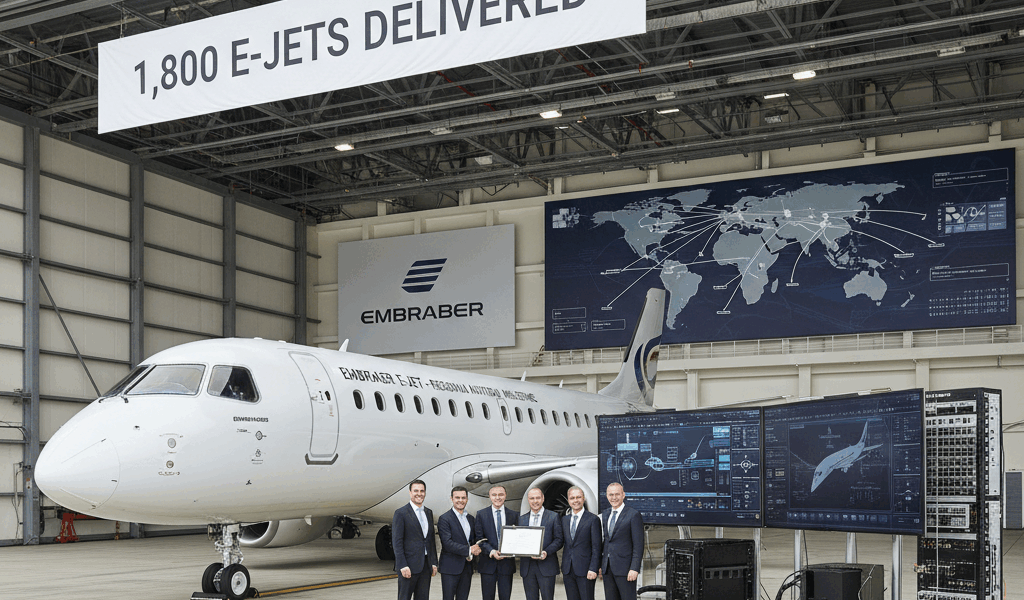
Embraer hitting 1,800 E-Jet deliveries is one of those milestones that sneaks up on you. As someone who has watched the regional jet market for years, I’ve seen the E-Jet go from a Brazilian underdog to the aircraft that essentially owns the 70-130 seat segment. That number deserves a closer look.
The 1,800th delivery was an E195-E2, the stretched second-generation variant, and it went to KLM Cityhopper. KLM’s regional operation has been one of the most visible E2 operators in Europe, running the type on routes out of Amsterdam where it replaced older Fokker 70s and first-generation E-Jets. Watching an E195-E2 taxi past the old KLM Fokker display at Schiphol is one of those aviation moments that connects the dots between eras.
How Embraer Got Here
Probably should have led with this section, honestly. Embraer launched the E-Jet family in the early 2000s when the regional jet market was dominated by Bombardier’s CRJ series. The CRJs were smaller, 50 to 90 seats, and not particularly comfortable. Embraer bet that airlines wanted a bigger regional jet with a wider cabin, and that bet paid off.
The original E170, E175, E190, and E195 offered two-by-two seating in economy, which meant no middle seats. That single detail drove passenger preference and helped airlines market the E-Jet as a premium regional experience. U.S. carriers like JetBlue built their early growth on the E190. Republic Airways, SkyWest, and Envoy operate fleets of E175s on behalf of the majors under scope clause agreements that limit regional aircraft to 76 seats.
The E2 generation, which started entering service in 2018, brought new Pratt & Whitney GTF engines, a redesigned wing, and updated avionics. Embraer claims 16-25% better fuel efficiency depending on the variant and mission. The E195-E2 stretches to 146 seats in a single-class layout, which pushes into territory that overlaps with the lower end of the Airbus A220-100.
The Competitive Landscape
Bombardier exited commercial aviation entirely, selling the CRJ program to Mitsubishi and eventually winding down the program altogether. That left Embraer as the only dedicated manufacturer in the sub-150-seat jet market. The Airbus A220, originally the Bombardier CSeries, competes at the upper end of Embraer’s range. Below that, Embraer has the field to itself.
That’s what makes the E-Jet franchise endearing to us regional aviation watchers. It didn’t win through flashy marketing or government subsidies. It won by building an aircraft that airlines genuinely wanted to operate and passengers didn’t mind flying on. The two-by-two cabin, the operating economics, and Embraer’s reputation for product support created a combination that Bombardier couldn’t match.
Where Things Stand Now
The order backlog sits around 300 E2 aircraft, with production targeting 12 to 15 deliveries per month through 2026. Embraer is working to ramp production rates as supply chain constraints ease. The E175, which remains the first-generation model still in production due to scope clause demand in the U.S., continues selling steadily alongside the E2 family.
The 1,800 delivery milestone won’t make headlines the way a new aircraft launch does, but it represents something more meaningful: sustained market acceptance over two decades. Building 1,800 of anything in aerospace takes consistent execution on manufacturing, support, and customer relationships. Embraer has done that, and the E-Jet’s installed base across 80-plus airlines in 50-plus countries proves it.



Stay in the loop
Get the latest aerodata updates delivered to your inbox.