Aircraft evacuation systems have gotten complicated with all the new certification requirements and design innovations flying around. As someone who has sat through more safety briefings than I can count and studied how these systems actually work, I learned everything there is to know about the equipment that gets passengers off an airplane in an emergency. Today, I will share it all with you.
The 90-Second Rule That Drives Everything
Probably should have led with this section, honestly. The FAA requires that every commercial aircraft be capable of evacuating all passengers and crew within 90 seconds using only half the available exits. That rule shapes every decision about evacuation system design. Ninety seconds. Half the doors. In the dark, with smoke, with passengers who’ve never practiced this before.
Airlines have to demonstrate compliance during certification testing with actual volunteers. These tests are intense. People get bruised, occasionally injured. The 90-second standard hasn’t changed in decades, but the aircraft have gotten bigger and seat counts have grown, which means the systems have to keep up.
The Slides That Deploy in Seconds
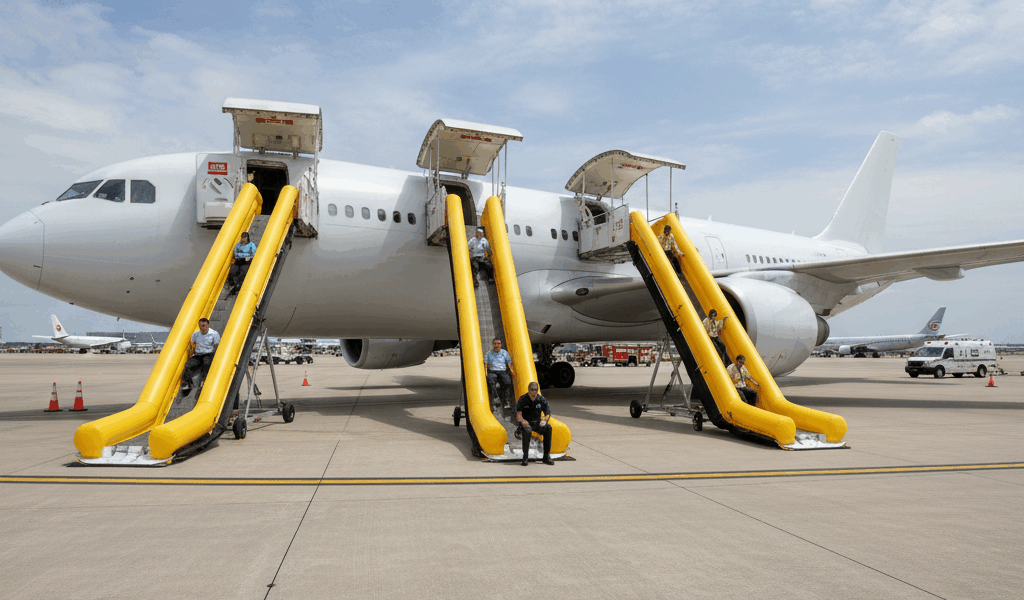
Those inflatable slides you see in safety cards are the backbone of the evacuation system. On most commercial jets, they’re packed into the door sills and deploy automatically when the door is opened in emergency mode. The inflation takes about six seconds on a narrow-body aircraft and up to ten seconds on a wide-body. The slide doubles as a raft on over-water equipped aircraft, which is why flight attendants refer to them as slide-rafts.
I watched a demonstration at an MRO facility where they deployed a 737 slide in a hangar. The thing inflated with a bang that echoed off the walls, and the force of deployment shoved the door frame noticeably. It’s not gentle. Flight attendants train on these regularly, and the first time you go down one during training, the speed surprises you. It’s steep, it’s fast, and you land harder than you’d expect.
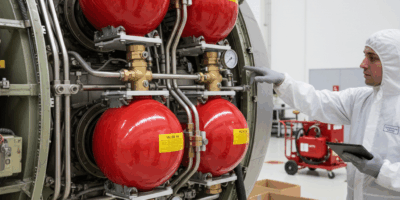
The slides use compressed gas canisters, typically nitrogen or CO2, stored in cylinders attached to the slide pack. These canisters have expiration dates and inspection intervals. A slide that fails to deploy because of a bad canister means an unusable exit, which directly threatens the 90-second evacuation requirement.
Emergency Lighting and Floor Tracks
When the cabin fills with smoke, visibility drops to almost nothing. That’s why aircraft have floor-level emergency lighting strips that run along the aisle and lead to each exit. These tracks are usually LED strips embedded in the carpet or floor panels, powered by the aircraft’s emergency battery system.
The concept is simple: smoke rises, so put the lights low where passengers crawling on the floor can still see them. I’m apparently the type of person who looks at the floor lighting every time I board, and on some older aircraft you can see where the strips have been replaced multiple times based on the color mismatch with the surrounding carpet.
Exit signs above each door are required to remain illuminated for at least ten minutes after a total power loss. Most modern aircraft use self-contained battery-powered exit signs as backup.
Overwing Exits and Hatches
The overwing exits on narrow-body aircraft like the 737 and A320 are smaller than main doors and don’t have slides. Passengers climb out onto the wing and either jump or use a small ramp to reach the ground. The wing surface is treated with non-skid coating to prevent people from sliding off, which is a real concern on a swept wing that sits several feet off the ground.
The person sitting in the exit row is effectively part of the evacuation system. That’s why flight attendants brief exit row passengers before every flight and why there are physical requirements for sitting there. You need to be able to lift the hatch, which weighs 40 to 60 pounds depending on the aircraft type, and toss it outside or place it on the seat. That briefing card in the seat pocket isn’t just legal cover. It’s a real operational need.
Fire Suppression Tied to Evacuation
Evacuation systems don’t work in isolation. They’re paired with fire suppression systems throughout the aircraft. Halon extinguishers in the cargo compartments activate automatically. Portable extinguishers are stowed in the cabin for crew use. Smoke detectors in the lavatories trigger both visual and audible alerts on the flight deck.
The cockpit crew’s decision to evacuate depends heavily on the fire situation. A post-landing engine fire might call for evacuation on one side only, keeping passengers away from the burning engine. The captain has to assess the situation, communicate with the cabin crew, and make the call. That coordination between cockpit and cabin is something that gets practiced in simulator sessions and recurrent training, because in a real emergency there’s no time to figure out the communication protocol on the fly.
How Design Has Evolved
Early commercial aircraft had rope systems and retractable stairs. The inflatable slide concept became standard in the 1960s as jet aircraft replaced prop-driven airliners and door sill heights increased. You can’t ask passengers to jump from a 737 door that sits eight feet above the ground. The slide solved that problem.
Frustrated by the limitations of single-lane slides on high-capacity aircraft, manufacturers developed dual-lane slides for wide-body doors. These allow two streams of passengers to evacuate simultaneously from each exit. The A380, with its upper deck, uses some of the longest evacuation slides ever built, reaching from the upper deck doors to the ground.
That’s what makes evacuation engineering endearing to us aviation people. It’s completely invisible when everything goes right. Nobody thinks about the slides, the floor lights, the exit signs. But when something goes wrong, those systems are the difference between everyone walking away and a disaster. The engineering behind them is meticulous, tested repeatedly, and taken seriously in a way that most passengers never appreciate.
Maintenance and Inspection
Slides are inspected on regular intervals and have mandatory overhaul periods. A typical slide gets pulled, sent to a certified repair station, inspected, repacked, and reinstalled. The canisters get hydrostatic tested. The fabric gets checked for wear and deterioration. It’s expensive work, several thousand dollars per slide per overhaul, but it’s non-negotiable.
Emergency lighting systems get tested during routine maintenance checks. Exit signs, floor tracks, and backup batteries all have inspection requirements. A single burned-out floor light might seem trivial, but multiply it across a smoke-filled cabin and every missing light is a passenger who loses track of the exit path.
The regulatory framework around evacuation systems is extensive. FAA and EASA both publish detailed requirements covering everything from slide inflation time to emergency lighting brightness to exit door opening force. Airlines and manufacturers take this seriously because the consequences of failure during an actual evacuation are severe and very public.


Stay in the loop
Get the latest aerodata updates delivered to your inbox.