45,000 Aircraft Overhead Right Now

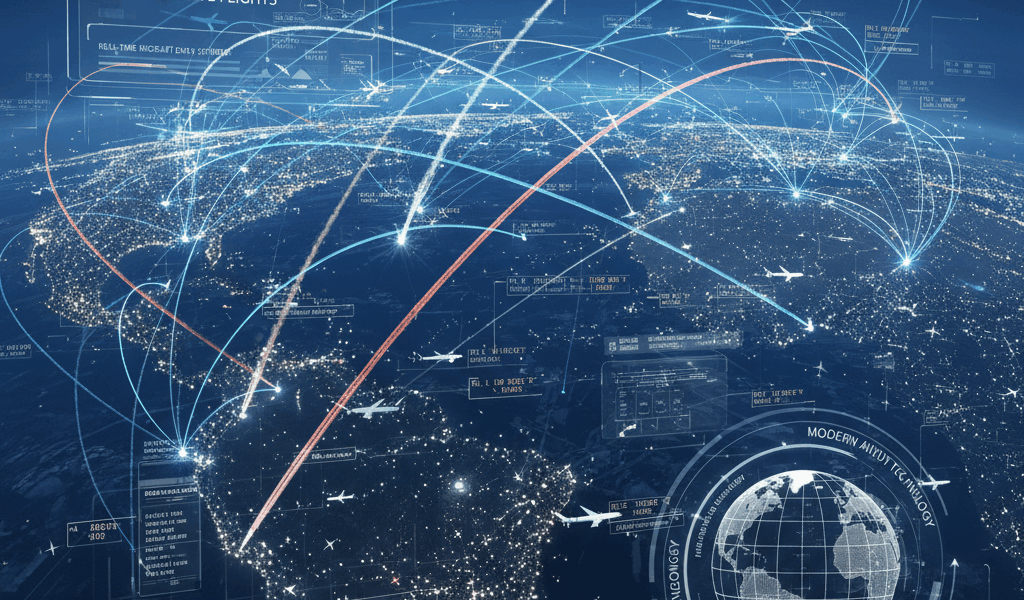
At any given moment, approximately 45,000 aircraft traverse the skies above us. This remarkable density of airborne traffic represents the culmination of a century of aviation development and the coordination of one of humanity’s most complex real-time systems.

Measuring the Sky’s Population

Flight tracking services like Flightradar24 and FlightAware aggregate data from multiple sources to provide this aircraft count. ADS-B transponders on equipped aircraft broadcast position data receivable by networks of ground stations. MLAT multilateration systems triangulate positions of aircraft with older transponder equipment. Satellite receivers extend coverage over oceans and remote regions.

The 45,000 figure represents peak traffic during global mid-day hours when European evening operations overlap with American afternoon and Asian morning flights. Traffic dips to approximately 20,000-25,000 during the global night lull between 06:00-10:00 UTC, then rebuilds as the day progresses westward around the planet.

Distribution Patterns

Aircraft distribution across the globe is remarkably uneven. North American and European airspace collectively host approximately 60% of global traffic despite covering only 15% of Earth’s surface. The North Atlantic corridor between these regions carries approximately 2,000 flights daily through a narrow band of oceanic airspace.

Asia-Pacific traffic has grown dramatically, now representing 25% of global movements. Chinese domestic airspace alone handles 15,000+ daily flights. Southeast Asian traffic density rivals European levels in regions like the Singapore-Bangkok corridor. Indian domestic aviation has tripled in the past decade, adding tens of thousands of daily movements.

Vertical Stratification

Those 45,000 aircraft occupy different vertical strata based on mission profiles. Commercial jets cruise between 31,000 and 42,000 feet, with eastbound traffic typically assigned odd thousands (35,000, 37,000) and westbound traffic even thousands (34,000, 36,000) per RVSM rules. Regional turboprops operate lower, typically between 20,000 and 28,000 feet.

General aviation occupies lower altitudes, with piston aircraft commonly operating below 15,000 feet. Helicopters operate below 3,000 feet except during longer transits. This vertical segregation creates separated traffic streams that reduce conflict potential while maximizing airspace utilization.

The Traffic Control Challenge

Managing 45,000 simultaneous aircraft requires extraordinary coordination. Globally, approximately 150,000 air traffic controllers work around the clock to maintain separation. They monitor radar screens showing thousands of targets, issuing instructions that collectively prevent collisions while optimizing flow.

The busiest facilities handle remarkable traffic densities. Atlanta TRACON controllers sequence 2,500+ daily arrivals and departures through a single airspace. London Area Control processes 5,000+ daily movements through British airspace. These controllers make thousands of decisions hourly, each maintaining the safety margins that prevent tragedy.

System Capacity Constraints

Despite sophisticated management, capacity limits constrain growth. The European airspace network regularly experiences flow management restrictions during peak periods. U.S. airspace capacity is projected to reach saturation by 2035 without significant infrastructure investment. The 45,000 number might represent approaching limits rather than sustainable routine.

New technologies promise expanded capacity. Advanced surveillance enables reduced separation standards. Data link communications allow more efficient controller-pilot exchanges. Trajectory-based operations could optimize four-dimensional paths through congested airspace. Each innovation buys additional capacity within finite sky.

Environmental Considerations

Those 45,000 aircraft collectively consume approximately 700 million liters of jet fuel daily, producing roughly 2.5% of global carbon dioxide emissions. Contrails from high-altitude operations contribute additional warming effects still being quantified by researchers. The environmental cost of our airborne population has become impossible to ignore.

Efficiency improvements offer partial solutions. Modern aircraft burn 40% less fuel per passenger-kilometer than their 1990s predecessors. Optimized routing and continuous descent approaches reduce emissions by 10-15% per flight. Sustainable aviation fuels promise 80% lifecycle carbon reduction when produced at scale.

A Living System

The 45,000 aircraft overhead represent a dynamic system constantly adjusting to demand, weather, and operational conditions. As you read this, approximately 3 million passengers are airborne alongside 200,000 tons of cargo. The sky that appears empty to casual observation hosts an invisible transportation network rivaling any ground infrastructure in complexity and scale.

Tomorrow, the number will be slightly different. Next year, pre-pandemic trends suggest 48,000 might be routine. The sky’s carrying capacity continues testing limits, while the industry works to ensure those 45,000 aircraft operate safely, efficiently, and with diminishing environmental impact.

Jason Michael

Jason Michael

Author & Expert

Jason Michael is a Pacific Northwest gardening enthusiast and longtime homeowner in the Seattle area. He enjoys growing vegetables, cultivating native plants, and experimenting with sustainable gardening practices suited to the region's unique climate.

9 Articles
View All Posts

Subscribe for Updates

Get the latest articles delivered to your inbox.