Today, I will share it all with you.
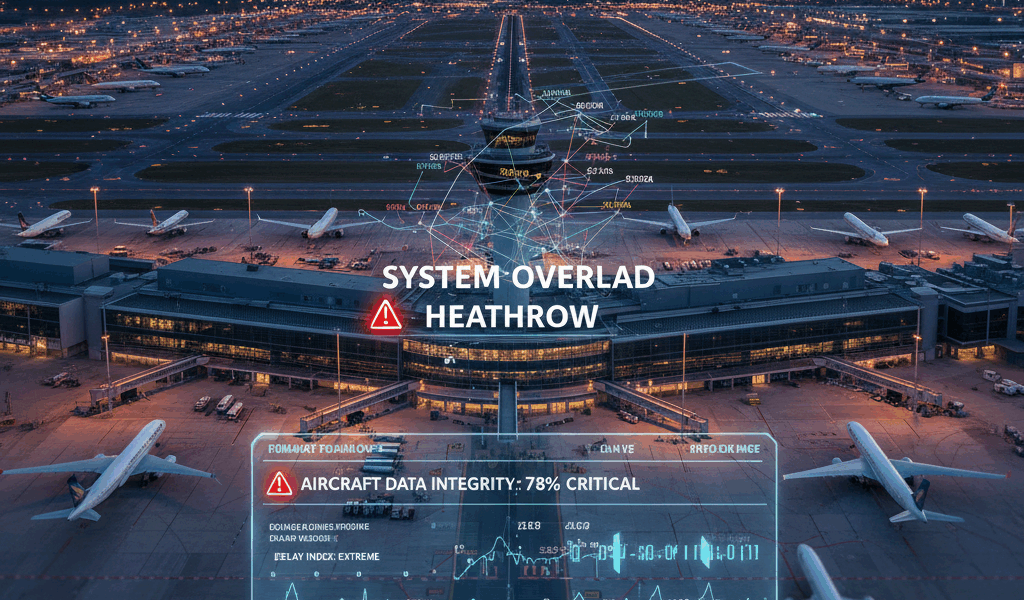
The numbers tell the story immediately: 1,300 flights daily. Over 80 million passengers annually. Running at 98% of its regulatory capacity limit. Heathrow is simultaneously the gold standard for airport efficiency and a warning about what happens when infrastructure can’t keep up.
The Two-Runway Challenge

Heathrow’s core problem is dead simple: two runways trying to serve demand that blew past supply years ago. Look at what the competition has to work with:
- London Heathrow: 2 runways, 480,000 annual movements (hard cap)
- Paris Charles de Gaulle: 4 runways, 500,000+ movements
- Amsterdam Schiphol: 6 runways, 500,000+ movements
- Frankfurt: 4 runways, 500,000+ movements
- Dubai: 2 runways but operates 24 hours, 400,000+ movements
That movement cap of 480,000 annual slots — imposed back in 2008 — means Heathrow runs at near-maximum during every single peak hour. A regulatory night flight ban squeezes all that traffic into daytime hours, making the crunch even tighter. I remember looking at the slot utilization data for the first time and thinking there was literally no room left in the schedule.
The Economics of Scarcity
Because the economics of Heathrow slot scarcity are genuinely wild.
A Heathrow slot pair — one takeoff, one landing, same time each day — has traded for as much as $75 million. That makes runway access at this one airport one of the most valuable commodities in all of aviation.
This scarcity shapes airline strategy in big ways:
Aircraft size matters hugely. Airlines pack as many passengers as possible into each precious slot by flying bigger planes. Heathrow sees a disproportionate share of widebody operations — A380s, 777s, A350s — even on routes where a smaller jet would work just fine at a less constrained airport.
Route prioritization is ruthless. Slots go to the routes generating the highest revenue. Business-heavy services to New York, Hong Kong, and major financial centers get priority over leisure destinations that can operate from less constrained airports.
Competition is structurally limited. British Airways controls roughly half of all Heathrow slots, creating a natural fortress position. New airlines trying to establish a meaningful presence face a nearly impossible barrier to entry.
Operational Excellence Under Pressure
I’ll give Heathrow’s controllers and operations teams credit — they’ve squeezed remarkable performance out of limited infrastructure:
Segregated mode operation: Each runway typically handles either arrivals or departures (not both), switching direction based on wind. This simplifies the controller’s job and actually enables higher movement rates than mixing arrivals and departures on the same runway.
Time-based separation: Heathrow pioneered a system that adjusts aircraft spacing based on wind conditions, safely adding 2-3 extra landings per hour during headwind conditions. Sounds small. Adds up fast over a full day.
Precise surface management: Ground movements are choreographed to minimize taxi times. Aircraft push back on a carefully timed schedule. There’s almost no wasted motion out there.
A-CDM: Real-time data sharing between airlines, ground handlers, and ATC lets everyone see what’s happening and plan proactively rather than reacting to surprises.
The Ripple Effect of Delays
Here’s where operating at full capacity gets genuinely painful. There is zero margin for error. None.
A single runway closure for 30 minutes during peak operations can delay 40+ flights. At most airports, you’d recover by running more movements later. At Heathrow? Every slot is already spoken for. There’s nothing to catch up with. The delays just stack up and bleed into the rest of the day.
Weather hits especially hard. Fog dropping visibility to CAT III conditions cuts arrival rates significantly, and those missed slots are gone forever. You can’t get them back.
The knock-on effects ripple across the entire European network and beyond. Late aircraft and crews from Heathrow cascade delays to connecting flights across the continent.
The Third Runway Debate
Britain has been arguing about expanding Heathrow for over 50 years. I’m not exaggerating. The proposed third runway would boost capacity by about 260,000 annual movements — a 54% increase. The projected benefits include:
- 740 additional destinations or increased frequencies
- 16 million more annual passengers
- Billions of pounds in estimated annual economic benefit
- Shorter connection times through more available slots
But opposition is fierce, and honestly, some of the concerns are legitimate:
Environmental impact: More flights mean more emissions and noise. The UK’s legally binding climate commitments create real tension with airport expansion plans.
Community disruption: The third runway would require demolishing parts of several villages and dramatically increasing noise exposure for surrounding areas. That’s not abstract — those are people’s homes.
Cost questions: Construction estimates exceed $20 billion equivalent. Who pays for that, and how does it hit landing fees?
Demand uncertainty: Post-pandemic travel patterns and the normalization of video conferencing have some smart people questioning whether the projected passenger growth will actually happen.
How Other Constrained Airports Cope
Heathrow isn’t alone in this. Other major airports deal with similar headaches:
New York area: Three major airports jammed together with nightmarishly complex airspace. Ground delay programs manage demand during peaks and weather events on an almost daily basis.
Tokyo Haneda: Added a fourth runway in 2010 and still can’t keep up. International slots are especially tight.
Sydney: A single-runway airport serving Australia’s largest city, with a hard curfew from 11pm to 6am. They’re building a second airport because there’s literally no other option.
Hong Kong: Ran its two runways at absolute capacity before a third opened in 2024. Still expanding to handle projected growth.
The Passenger Experience
If you’ve flown through Heathrow, you’ve probably felt the constraints without realizing why:
Higher fares: Limited competition and slot scarcity translate directly to premium pricing on Heathrow routes versus alternative airports.
Connection stress: Tight scheduling leaves almost no buffer for delays. Minimum connection times assume perfection, which is a bold assumption at a 98%-utilized airport.
Clustered flight times: Those morning US departures bunched between 9-11am? That’s driven by slot availability, not because airlines think that’s the ideal time.
Crowded terminals: Facilities designed for lower volumes now handle record traffic, and during peak periods it shows.
Future Outlook
Several things will shape where Heathrow goes from here:
Airspace modernization: The UK’s FASI-N program aims to redesign London-area airspace. More efficient routing could unlock modest capacity gains from existing infrastructure.
Environmental regulation: Sustainability rules may force demand management through emissions caps rather than just movement caps. That’s a fundamentally different constraint.
Better technology: Improved navigation and automation could enable slightly higher movement rates, but we’re talking incremental gains, not breakthroughs.
Competitive pressure: European hubs keep expanding. If Heathrow stays constrained, traffic and airlines may eventually drift to airports that can actually grow.
Key Takeaways
- Heathrow operates at 98% capacity with just two runways handling 80 million passengers annually
- Slot scarcity has driven valuations up to $75 million per slot pair
- Running at capacity means zero recovery margin when anything goes wrong
- Third runway expansion remains politically and environmentally contentious after 50+ years of debate
- Airlines maximize their limited slots by deploying larger aircraft and focusing on premium routes
Data sources: Heathrow Airport Holdings, UK Civil Aviation Authority, Airport Coordination Limited, aviation industry reports




Stay in the loop
Get the latest aerodata updates delivered to your inbox.