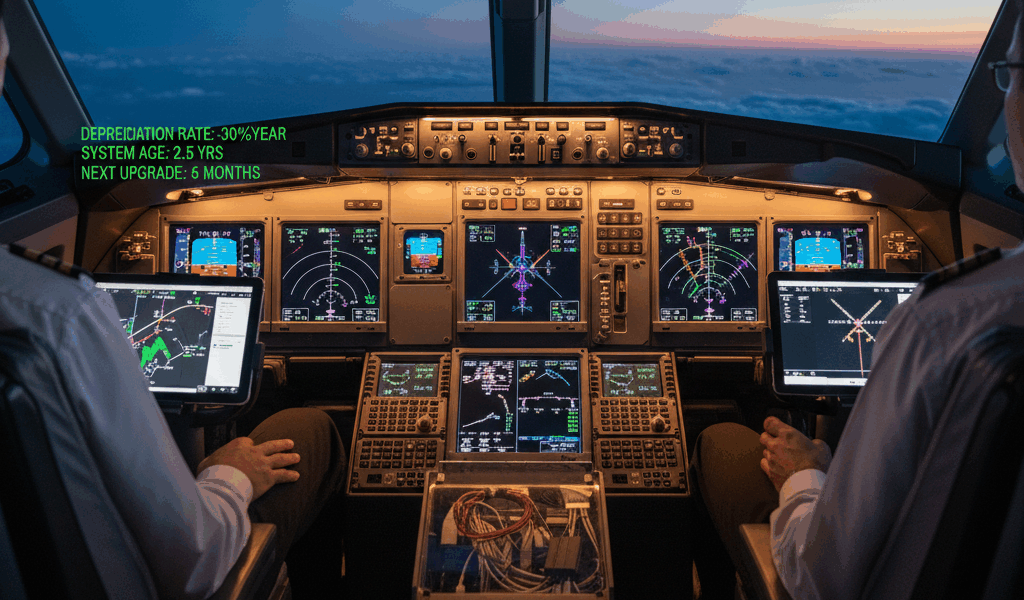
Commercial aircraft lose value at predictable rates that shape airline financial strategies. A new narrowbody worth $55 million becomes a $25 million asset after a decade. Understanding this depreciation curve reveals crucial insights into fleet economics and airline decision-making.
The Depreciation Curve
Aircraft depreciate along a declining curve rather than straight-line schedule. New aircraft lose value most rapidly, with first-year depreciation often exceeding 15%. Rates moderate as aircraft age, dropping to 5-7% annually for mid-life equipment. Very old aircraft may hold residual value as values approach scrap and part-out levels.
A Boeing 737 MAX 8 delivers at approximately $55 million market value. After one year, market value drops to $47-48 million. At five years, values typically reach $35-38 million. At ten years, expect $22-26 million. The pattern repeats across aircraft types with variations based on demand and operating economics.
What Drives Depreciation
Multiple factors influence depreciation rates. Fuel efficiency relative to newer alternatives creates economic obsolescence. A 15-year-old 737NG burns 15% more fuel than a new MAX, reducing its value to operators facing high fuel costs. Technology shifts accelerate this effect.
Maintenance status significantly affects market value. Aircraft approaching major checks trade at discounts reflecting impending costs. A widebody approaching a $15 million D-check might trade $12-15 million below an aircraft fresh from similar maintenance. Buyers factor maintenance timing into pricing.
Engine age and condition represent substantial value drivers. Engines comprise 40-50% of aircraft value and have their own depreciation curves. Low-cycle engines on young airframes command premiums. High-time engines approaching shop visits discount accordingly.
Accounting vs. Market Value
Airlines depreciate aircraft on their books over 20-30 year useful lives to zero or modest residual values. This accounting treatment rarely matches market reality. An airline carrying a 737 at $15 million book value might find market values of $25 million, creating hidden asset value. Conversely, distressed sales during industry downturns may realize prices below book value, triggering impairment charges.
The COVID-19 period illustrated this disconnect dramatically. Airlines wrote down billions in aircraft value as market prices collapsed. Some aircraft sold for 40% below pre-pandemic values as desperate sellers met hesitant buyers. The market has since recovered, leaving buyers who acquired distressed assets with substantial gains.
Lessor Perspectives
Aircraft leasing companies own approximately 50% of the global fleet, making residual value risk their central concern. Lessors price lease rates to recover investment over the lease term while assuming aircraft return with residual value sufficient to release or sell profitably.
Lease rates implicitly reflect depreciation assumptions. A lessor purchasing a new 737 MAX for $55 million might seek lease rates of $350,000 monthly over a 12-year term. The $50.4 million collected, combined with assumed $15 million residual value, covers acquisition cost plus target returns. Residual value assumptions drive the entire calculation.
Fleet Planning Implications
Airlines structure fleets knowing depreciation patterns. Operating new aircraft during rapid depreciation years and returning them to lessors before major maintenance becomes a common strategy. Airlines might own aircraft they intend to operate for 20+ years while leasing shorter-term capacity.
Retirement timing reflects depreciation economics. When an aircraft’s market value approaches its scrap and part-out value, continued operation becomes the only path to value extraction. This explains why 25-year-old 757s remain in service: their negligible market value means retirement destroys no asset value while continued operation generates revenue.
The Residual Value Wildcard
Predicting future residual values remains aviation’s great uncertainty. Aircraft that appear to have decades of life may face early obsolescence if fuel prices spike or emissions regulations tighten. Conversely, supply constraints may elevate values above historical patterns as airlines compete for scarce equipment.
The 737 MAX grounding illustrated residual value volatility. During the crisis, MAX values collapsed 30-40% as operators faced uncertain return to service. Post-recertification, values recovered fully as the aircraft resumed its position as the most popular narrowbody type.
Depreciation at 30,000 feet follows patterns but surprises regularly. The airlines and lessors that navigate these currents successfully generate returns while those who misread depreciation trajectories suffer losses. Understanding the curves provides essential insight into aviation’s financial dynamics.
Subscribe for Updates
Get the latest articles delivered to your inbox.
We respect your privacy. Unsubscribe anytime.