Not All Military Aircraft Are Hidden on Purpose
Military flight tracking has gotten complicated with all the misinformation flying around. As someone who picked up flight tracking during the pandemic lockdowns — like a lot of bored people did in 2020 — I learned everything there is to know about why military aircraft vanish from your screen. Today, I will share it all with you.
My first assumption was embarrassingly wrong. I spent about three months convinced that every disappearing military aircraft was some classified black-ops situation. Turns out, a US Air Force C-17 Globemaster shows up on Flightradar24 all the time during routine training runs. British RAF transport planes broadcast continuously on certain routes. That was a humbling realization, honestly.
What actually controls whether you see a military flight is a messy tangle of technical gaps, legal frameworks, and operator choices — not some blanket secrecy policy. The reality is far more interesting than “military = invisible.”
How Flight Trackers Actually Pick Up Aircraft
Before any of the disappearance stuff makes sense, you need the basics on how trackers see aircraft at all. So, without further ado, let’s dive in.
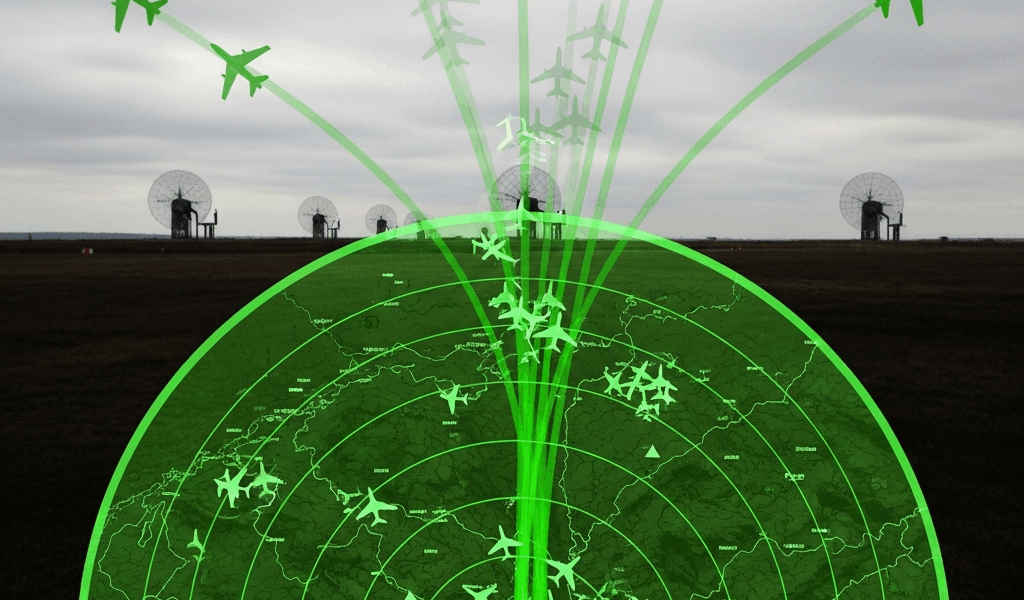
Platforms like Flightradar24 and FlightAware run on something called Automatic Dependent Surveillance—Broadcast, or ADS-B. Aircraft transmit their position, altitude, speed, and ID roughly once per second. Ground receivers catch that signal. Commercial operators in the US and Europe are legally required to have ADS-B Out transponders — it’s not optional in controlled airspace.
Military aircraft are a different story. They carry Mode S transponders — older technology, more selective about what data it shares. Mode S was built for radar environments, not civilian surveillance networks. Civilian receivers can still decode Mode S transmissions, but what information actually comes through depends on the receiver hardware and how the operator configured their system.
Here’s the part that surprised me: tracking networks depend on a mesh of ground receivers. Dense in the US and Europe. Basically nonexistent over the mid-Atlantic or rural Southeast Asia. Military aircraft operating in those gaps — or flying at altitudes outside typical receiver range — don’t appear on your screen. Nobody’s hiding them. The infrastructure simply isn’t there to catch them.
Multilateration, or MLAT, makes this worse in the gaps. MLAT pinpoints aircraft by measuring timing differences across multiple receivers — brilliant when coverage is good, completely useless when an aircraft enters sparse-receiver airspace. Military flights operate in exactly those zones constantly. That explains a lot of the mid-route disappearances right there.
The LADD Program and the PIA System Explained
Probably should have opened with this section, honestly. This is where legal frameworks and voluntary opt-outs actually come into play.
The FAA runs the Limiting Aircraft Data Displayed program — LADD. Under LADD, operators request that their tail number get masked on public trackers. Instead of seeing “N12345,” you see a hex code like “AE1234” that rotates regularly. Military operators, government aircraft, and anyone with legitimate security concerns can use LADD to prevent real-time tail number tracking while still broadcasting for standard safety compliance.
But what is LADD, really? In essence, it’s a masking system for tail numbers. But it’s much more than that — it’s the legal mechanism that lets military aircraft operate safely in civilian airspace without handing observers a direct connection between a flight path and a specific aircraft.
LADD doesn’t make anything invisible, though. Open-source tracking communities maintain databases that map hex codes back to known aircraft. I’m apparently obsessive enough to have bookmarked three of those databases, and cross-referencing them works for me while relying on any single source never does. Don’t make my mistake — use multiple references.
The Privacy ICAO Address system, or PIA, works similarly but operates globally. ICAO addresses are the unique identifiers air traffic control uses to distinguish aircraft. Under PIA, sensitive operators get temporary ICAO addresses that rotate, or they use a static PIA address that’s deliberately disconnected from their real aircraft ID. When a tracker flags a PIA address, something is being shielded — the question is always what.
Neither LADD nor PIA is about making aircraft vanish. Both exist to prevent ground observers from drawing a straight line between a flight path and a specific tail number. For classified operations or high-value military movements, operators skip ADS-B and Mode S broadcasting entirely — no system needed.
Why Some Military Flights Appear Then Disappear Mid-Route
This one drove me genuinely crazy for weeks.
You’ll spot a C-130 Hercules on your tracker, follow it through fifteen minutes and three waypoints, then — gone. No landing. No explanation. Just gone.
First possibility: transponder mode changes. Military crews routinely operate in ADS-B mode through civilian airspace, then switch to Mode S-only or cut broadcasting entirely when they enter military-controlled zones. Completely legal. The tracker loses the signal the moment the format changes.
Second possibility: receiver handoff failures. Aircraft moving across regions hand off between ground receiver networks. Civilian networks manage this smoothly. Sparse-coverage areas don’t. The aircraft crosses into a zone with zero civilian receivers — it’s still flying at 28,000 feet, you’ve just lost the thread.
Third — and this is valuable context most people miss — different aggregators show radically different amounts of military traffic. ADS-B Exchange applies far fewer filters than Flightradar24. Mode S signals and unusual transponder codes that vanish from Flightradar24 show up clearly on ADS-B Exchange. That’s not about one platform tracking better. It’s policy. Flightradar24 filters aggressively for privacy and accuracy. ADS-B Exchange shows everything its receivers catch. That’s what makes ADS-B Exchange endearing to us obsessive tracker types.
What the Gaps in the Data Actually Tell You
Disappearance carries information. Once you know the mechanics, the patterns start telling a story.
A military aircraft that appears over civilian airspace, broadcasts for a few minutes, then drops off — it probably switched modes or left receiver coverage. You can’t determine the mission from that. But you can reasonably conclude the crew prioritized radar deconfliction while moving through busy airspace. That’s a meaningful data point.
An aircraft that never appears at all is either outside receiver coverage, transmitting Mode S with minimal data, or not broadcasting at all. The first case is by far the most common. The last is genuinely rare — reserved for operations that actually warrant it.
The honest thing to say here: the overwhelming majority of military flights you’ll never see on your tracker are invisible because civilian infrastructure doesn’t cover where they operate. The Pacific Ocean. Remote ranges in Nevada. Low-altitude training corridors in Montana with exactly zero receivers within 200 miles. Nobody’s running a suppression operation — the coverage just isn’t there.
While you won’t need professional aviation subscriptions or government data access, you will need a handful of the right tools. ADS-B Exchange might be the best option, as military tracking requires unfiltered data. That is because ADS-B Exchange archives everything its crowdsourced receiver network catches — nothing gets filtered before you see it. First, you should cross-reference with Flightradar24 — at least if you want cleaner, more accurate positional data alongside the raw stuff. Both platforms are completely public. Both are entirely legal to use. Neither surfaces anything a careful observer couldn’t piece together from open sources anyway.




Stay in the loop
Get the latest aerodata updates delivered to your inbox.