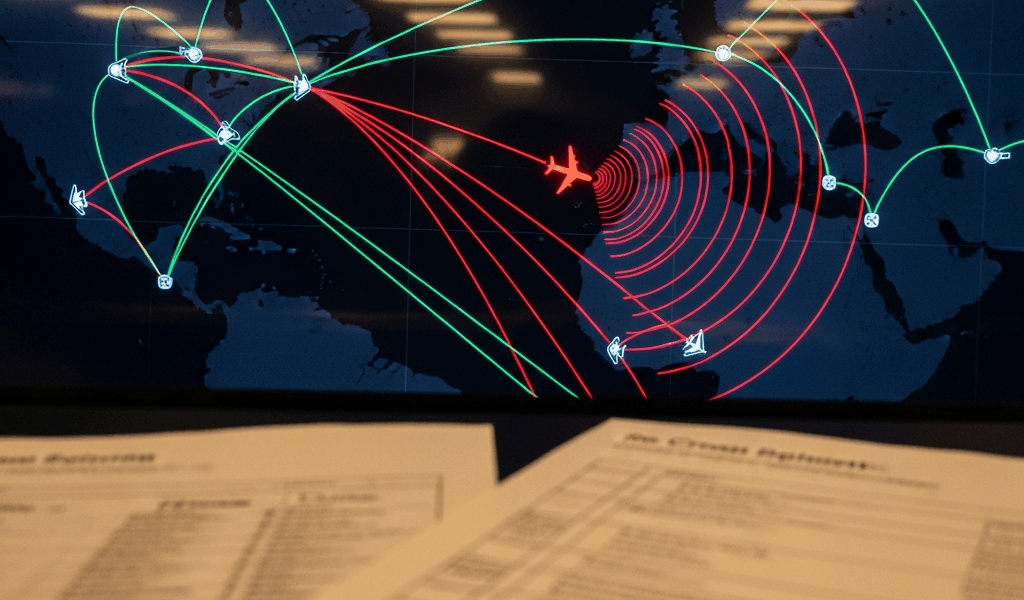
One Late Plane Serves Four Cities in a Day
Flight delays have gotten complicated with all the vague airline jargon flying around. “Waiting on inbound equipment.” “Operational constraints.” You’ve seen these explanations on the departure board and thought — what does that actually mean? I’ve been there. After obsessively tracking my own flights for the better part of three years, I learned everything there is to know about why one late plane can wreck an entire day of travel across multiple states. Today, I will share it all with you.
Here’s the thing most people miss: the aircraft sitting at your gate this morning didn’t start its day with your flight. It probably slept in a completely different city.
A Boeing 737 — let’s say a -800 series — might depart Miami at 6:15 a.m., touch down in Atlanta around 8:40 a.m., turn around in 45 minutes, then push back for Charlotte at 9:25 a.m. Lands at 10:55. Sits for an hour. Heads to Nashville. Then Memphis. Then back to Atlanta. Possibly one more leg before parking for the night. That’s five cities in roughly 15 hours of elapsed time, and the whole thing runs on margins tighter than a carry-on in an overhead bin.
So when that Miami departure leaves 40 minutes late because of a ground delay in Florida, Atlanta passengers aren’t just 40 minutes late. That 45-minute turnaround gets compressed into maybe five minutes of actual usable work time. The ground crew rushes. Boarding gets chaotic. The catering truck is still loading when the crew wants to push back. Charlotte departs 50 minutes late instead of on time.
One delay. Five cities. Multiple downstream disasters.
I figured this out the hard way. What looked like a routine 2-hour wait in Dallas — I’d assumed it was gate congestion, honestly — turned out to trace back to weather in Denver from three hours earlier. I pulled up FlightRadar24, found the tail number on my aircraft, and watched it just sitting there on the Denver tarmac, frozen in time. That single Colorado weather event was the real cause of my entire afternoon falling apart.
Why the Inbound Aircraft Is Almost Always the Real Cause
Probably should have opened with this section, honestly. It’s the core mechanism — the one nobody thinks about until they’re already delayed and staring at a gate agent who can’t tell them anything useful.
Airlines schedule tight turnarounds on purpose. A 45-minute ground time isn’t an accident. It’s the minimum viable window to refuel, deplane, clean, board, and push back. Some regional jets — your Embraer 175s, your CRJ-700s — run on 30-minute turns. Why so tight? Aircraft utilization. A plane flying 10 legs per day instead of 8 generates millions in additional annual revenue. So the schedule gets built with almost zero buffer, by design.
The consequence is fragility. When the inbound aircraft slips 30 minutes, the outbound flight has almost no room to absorb it. The crew is already positioning. Boarding doors are scheduled to close at a specific time. The catering truck was ordered for 2:45 p.m., not 3:15 p.m. Ground handlers have already queued the next flight on their sheet.
Most passengers treat “waiting on inbound equipment” like a polite dodge. It’s actually the most honest explanation an airline can give you. The plane isn’t there. Until it is, you aren’t going anywhere either.
Here’s what a 30-minute slip really costs in practice. Inbound was supposed to land at 2:15 p.m. — now it’s 2:45 p.m. Your outbound was scheduled for 3:30 p.m. Minimum 45 minutes needed to prep the aircraft. So your departure is 3:45 p.m. at the absolute earliest. Factor in crew positioning issues and a possible gate conflict, and suddenly it’s 4:15 p.m.
That’s how 30 minutes quietly becomes 90 minutes. No drama. No announcement. Just math.
Crew Legality Makes It Worse
The FAA regulates exactly how many hours a pilot or flight attendant can work in a single duty period. For most commercial pilots, that’s 8 to 9 hours per day — depending on the number of flight segments and how much rest they had between legs. These aren’t suggestions. They’re federal law.
When the inbound aircraft runs late, the crew’s numbers change immediately. A crew that boarded their first flight at 6 a.m. with 9 hours of available duty time might be sitting at 5 hours remaining by the time they land late. If their next three legs total 4.5 hours of flight time plus turnarounds, they’re suddenly illegal to continue. The airline has to find a fresh crew.
Fresh crews don’t appear instantly. They might be on FAA-mandated rest. They might need 20 minutes just to walk from the pilot lounge to the aircraft. Then there’s the flight plan review, weather briefing, and the walk-around inspection of the plane itself. That 30-minute slip in the inbound has now become a 90-minute delay by the time the replacement crew is actually strapped in and ready.
I watched this happen in real time once on crew tracking data — a 45-minute late arrival from Denver forced a crew swap in Kansas City that added 67 minutes to the outbound departure. The captain and first officer who flew in couldn’t legally take the next three legs. Don’t make my mistake of assuming crew swaps are fast. They almost never are.
How Slot Controls and Ground Stops Lock In the Damage
When thunderstorms roll over Chicago’s airspace, the FAA issues a Ground Stop. Every aircraft headed to Chicago gets held at its origin airport — full stop, nobody moves. That part most travelers understand.
But what happens when the stop lifts two hours later? The FAA doesn’t just open the floodgates. They release aircraft on a sequenced schedule using assigned departure slot times. Maybe one slot per minute. Maybe every 90 seconds, depending on how much capacity the system can absorb. Your aircraft could be fully boarded, fueled, and ready to push back the moment the stop lifts — and you’d still wait 20 minutes for your assigned slot. That recovered time vanishes into the queue.
The same logic governs push-back sequencing on a normal day. Fifteen aircraft can’t simultaneously push back from Chicago’s gates. ATC sequences them — Aircraft A at 3:17 p.m., Aircraft B at 3:19 p.m., Aircraft C at 3:21 p.m. That’s how gridlock gets prevented. That’s also why “ready to push” and “actually pushing” are two completely different moments.
FlightRadar24 makes this visible if you know what to look for. Watch a busy airport after storms clear — you’ll see aircraft showing consistent four- to five-minute gaps between sequential departures, the physical fingerprint of ATC sequencing reasserting order over chaos.
What the Data Actually Shows About Delay Propagation
The Bureau of Transportation Statistics publishes monthly delay data broken down by time of day, and the pattern is striking every single time. Morning flights — your 7 a.m. and 8 a.m. departures — average significantly lower delays than evening flights. An early departure has cleaner assumptions. Fewer aircraft have cycled through the system. Fewer opportunities for something upstream to have gone wrong.
By 5 p.m., the morning’s chaos has fully propagated forward. A 7 a.m. arrival delay might have touched seven different aircraft rotations by the time the sun goes down. Each affected flight has tighter margins. Each compressed turnaround adds another fragility point to the network.
I’m apparently someone who now books the 6:45 a.m. flight whenever possible — and getting that first departure of the day works for me while evening flights never seem to. The data backs this up completely.
Airlines have started using predictive delay modeling to identify propagation chains before they fully develop. Operations centers analyze current aircraft positions, crew duty time remaining, and scheduled rotations in real time — sometimes spotting where a single inbound delay will cascade into three downstream disruptions and repositioning equipment to break the chain before passengers even notice anything is wrong.
That’s what makes rotation logic endearing to us obsessive flight-trackers. Delays aren’t random. They’re predictable. And once you see the pattern, you can never un-see it — every departure board becomes a logic puzzle with its answer hidden somewhere over Denver, three hours ago.




Stay in the loop
Get the latest aerodata updates delivered to your inbox.