What Is ACARS and How Does It Work? The System Behind Cockpit Messages
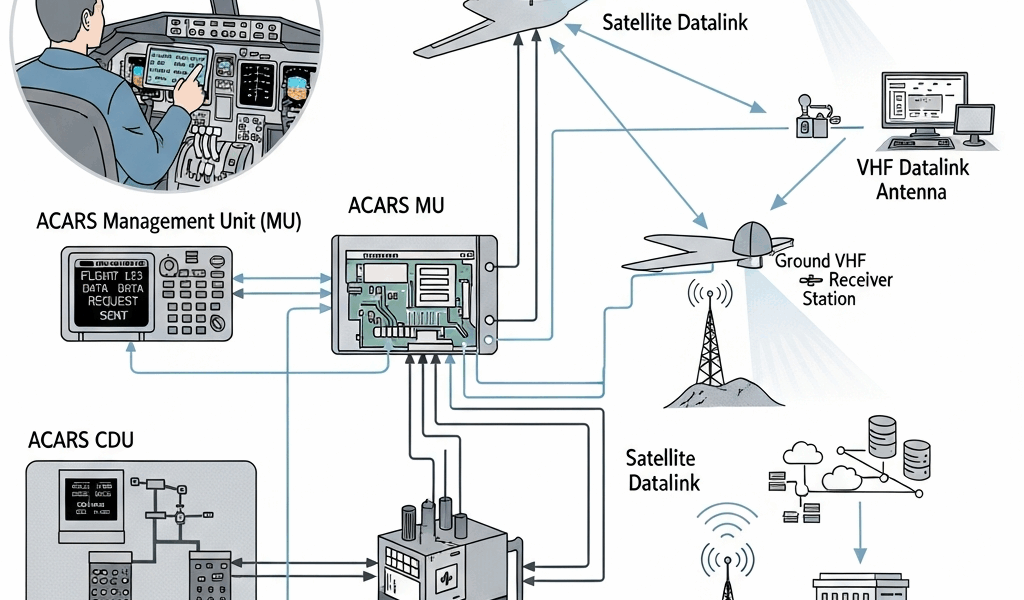
What is ACARS aviation enthusiasts keep referencing in forums and flight tracking communities? It’s the question I had after spending an embarrassing amount of time watching planespotting videos without understanding half the terminology. ACARS — Aircraft Communications Addressing and Reporting System — is essentially a digital text messaging network for aircraft, and it has been quietly running commercial aviation since 1978. Most passengers have no idea it exists. Most people outside aviation don’t either. But it’s been sitting there in the background of nearly every flight you’ve ever taken, passing critical data between the cockpit and the ground while you were arguing over the armrest.
ACARS in Plain English
Think of ACARS as SMS for airplanes. Not the glamorous internet connectivity that airlines advertise on their websites — this is a completely separate, purpose-built system that predates your cell phone by decades. It runs on VHF radio frequencies (primarily 129.125 MHz in North America), HF radio, and satellite links depending on where the aircraft is operating. The messages are short, structured, and sent automatically or manually between the aircraft and ground stations operated by service providers like SITA and ARINC.
The system was developed by Aeronautical Radio, Incorporated and first deployed by All Nippon Airways in 1978. That’s not a typo. This infrastructure is older than the original IBM PC. Airlines adopted it quickly because it solved a genuinely painful operational problem: getting real-time information to and from a moving aircraft without tying up voice radio communications for routine updates.
Here’s what ACARS actually handles on a typical flight:
- Pre-Departure Clearances (PDC) — Instead of a pilot copying down a complex ATC clearance by hand over voice radio, the clearance gets sent as a text message to the cockpit. Fewer readback errors. Cleaner workflow.
- Oceanic Clearances — Over the North Atlantic where radar coverage doesn’t exist, position reports and route clearances flow through ACARS via HF or satellite.
- ATIS via D-ATIS — The automated weather and airport information you normally hear on a recorded radio loop gets delivered as a digital message instead.
- Out/Off/On/In Times — Every time a door closes, the plane lifts off, touches down, or reaches the gate, ACARS sends a timestamped event message automatically. Airlines use this data for everything from billing to performance tracking.
- Weather Updates — METARs, TAFs, SIGMETs delivered directly to the flight management system.
- Gate Changes and Operational Messages — Airline operations centers can push messages directly to the cockpit. “Gate changed from B12 to C44.” “Catering delayed 20 minutes.” Routine stuff, but important.
- Engine Performance Data — Modern aircraft with ACARS uplinks can automatically send engine health data during flight. Maintenance teams on the ground can read it before the plane lands.
The hardware side of this lives in a box called the CMU — Communications Management Unit — or sometimes the ACARS Management Unit (AMU) depending on aircraft generation. On a Boeing 737NG, that’s typically a Honeywell or Rockwell Collins unit mounted in the avionics bay. On an Airbus A320, you’re looking at the ATSU, the Air Traffic Service Unit, which handles ACARS among other datalink functions. Pilots interact with it through the MCDU — that small screen and keypad in the center console that you sometimes glimpse in cockpit photos.
The messages are compressed down to very small packet sizes. We’re not talking broadband. The original VHF ACARS channel has a data rate of 2,400 bits per second. That’s intentionally lean. The whole design philosophy is reliability over bandwidth, and that philosophy has kept it running for over four decades.
What ACARS Messages Look Like
Probably should have opened with this section, honestly — because seeing an actual ACARS message is what makes the whole system click.
ACARS messages follow a structured format that looks almost alien if you’re not used to it. Here’s a simplified example of what a PDC (Pre-Departure Clearance) message looks like when it arrives in a cockpit:
PDC MSG 0042
CLEARED TO KJFK VIA MACKS2 DEPARTURE
CLIMB VIA SID EXCEPT MAINTAIN 5000
EXPECT FL360 10 MIN AFTER DEP
SQUAWK 4721
DEP FREQ 124.075
That message replaced a voice readback that would have taken two to three minutes and introduced real potential for transcription errors. The pilot reads it, confirms it’s accurate, and sends a WILCO acknowledgment back. Done.
The downlink messages — the ones going from aircraft to ground — look different. An automatic position report over the ocean might contain fields like this:
POS REPORT
FLT UA928
POSN 52N040W
TIME 1423Z
ALT FL370
NEXT WPT 56N030W ETA 1501Z
What’s fascinating — and I genuinely fell down a rabbit hole on this for about three hours one evening — is that civilians can receive and decode ACARS transmissions with nothing more than a basic software-defined radio dongle. An RTL-SDR USB stick costs around $25 to $35. Pair that with free software like ACARSDECO2 or VDL Mode 2 decoder software, and you can read the actual data being transmitted from aircraft overhead in real time.
I tried this myself with a NooElec NESDR SMArt v4 dongle and an indoor antenna sitting on my desk. Within about 20 minutes of setup, I was reading OUT/OFF/ON/IN reports from regional jets operating into my local airport. Out of context, messages like “UAL1234 OFF 1347Z” look like nothing. Understanding that “OFF” means wheels left the ground at 13:47 UTC and that this timestamp is now flowing into United’s operations center, maintenance systems, and passenger rebooking algorithms — that’s when you realize how much invisible infrastructure exists around commercial aviation.
There’s also a message type called ACARS free text, which lets dispatchers and pilots exchange messages that aren’t tied to a fixed format. Flight crews use these for operational questions that don’t fit a standard template. “Maintenance confirms issue with APU bleed valve. MEL allows dispatch. Documents loaded.” That kind of communication used to require a company radio frequency and a dedicated operator on the ground. ACARS made it asynchronous and automatic.
The Label System — How ACARS Knows What Type of Message It Is
Every ACARS message carries a two-character label field that identifies the message type. Label “Q0” is a PDC request. Label “H1” is a free text message. Label “16” is a weather request. There are hundreds of defined labels across different airline customizations and system vendors. Airlines define their own subsets of labels for proprietary operational messages.
Fascinated by this after making the mistake of assuming ACARS was just one standardized protocol, I went back and read through the ARINC 618 and ARINC 620 specifications. Those documents define the over-the-air character set and message format standards. They’re dry reading. But they explain why a message sent from a 737 operated by one airline can be correctly interpreted by a ground system operated by a completely different service provider. Standardization is what holds all of this together.
Why ACARS Still Matters in the Age of WiFi
This is the question I kept running into when I first started learning about ACARS. Why does a system from 1978 still exist when aircraft have satellite WiFi? Why are pilots using what amounts to a pager network when passengers in the back are streaming Netflix?
The answer has multiple layers, and none of them are “because airlines are slow to change” — though that would be an easy conclusion.
First: certification. Any system used for safety-critical communications in commercial aviation must meet DO-178C software standards and go through a certification process with aviation authorities. The passenger WiFi system on your flight is completely air-gapped from flight-critical systems. It has to be. You cannot reroute ACARS traffic through the same network as in-flight entertainment without creating an entirely new certification problem. The separation is intentional and regulatory.
Second: ACARS operates on dedicated aviation frequencies with prioritized access. VHF aviation datalink doesn’t compete with passenger bandwidth. It doesn’t get congested when 200 people try to load Instagram simultaneously during descent. It’s there, it’s allocated, it works.
Third: redundancy is the whole game in aviation. ACARS operates across three transport layers — VHF, HF, and satellite — and modern ACARS Management Units can automatically select the best available link and switch between them without crew action. Lose VHF coverage over the Pacific? The system shifts to satellite. The design assumes individual links will fail and routes around that failure automatically.
ACARS and FANS — Not Competitors, Partners
FANS — Future Air Navigation System — gets mentioned alongside ACARS constantly, and the relationship confused me for a long time. FANS 1/A is not a replacement for ACARS. It’s an application that runs on top of ACARS (and also on top of ATN, the Aeronautical Telecommunication Network, in certain regions). FANS 1/A provides Controller-Pilot Datalink Communications (CPDLC) — the ability for ATC controllers to send clearances and instructions directly to the cockpit as text rather than voice. The transport mechanism underneath can be ACARS.
Over the North Atlantic, FANS 1/A via ACARS is required equipment for operating in PBCS airspace at certain track levels. That’s a regulatory mandate, not an option. CPDLC messages like “CLIMB TO FL380” flow through the same ACARS infrastructure that’s been carrying messages since Jimmy Carter was president.
Struck by how invisible this infrastructure is to the average traveler, I once asked a gate agent at a mid-sized regional airport if she’d ever heard of ACARS. She had not. Neither had two people in my general aviation ground school class when I brought it up. The system processes millions of messages per day across the global commercial fleet and almost nobody outside aviation operations knows it exists.
Airlines like Delta, United, and American process ACARS data through operations control centers that monitor the entire fleet in real time. When a flight is delayed on the ground, the OUT time doesn’t update. The operations center sees that immediately. Crew scheduling systems, maintenance control, gate assignment software — they’re all consuming ACARS event messages as inputs. The $35 RTL-SDR dongle sitting on my desk is pulling a tiny slice of a data network that underpins the logistics of moving 45,000 commercial flights per day in the United States alone.
ACARS isn’t going away. VDL Mode 2, the newer VHF datalink standard that offers roughly ten times the data rate of original ACARS at 31,500 bits per second, is already deployed on newer aircraft and is the mandated datalink standard in European airspace. The protocols evolve. The fundamental architecture — short, structured, reliable messages between cockpit and ground — stays exactly the same. Because it works. It has worked since 1978. And every time you board a flight and the pilot reads a clearance off a screen instead of copying it down in a notepad, you’re watching four decades of invisible infrastructure do its job.

Stay in the loop
Get the latest aerodata updates delivered to your inbox.