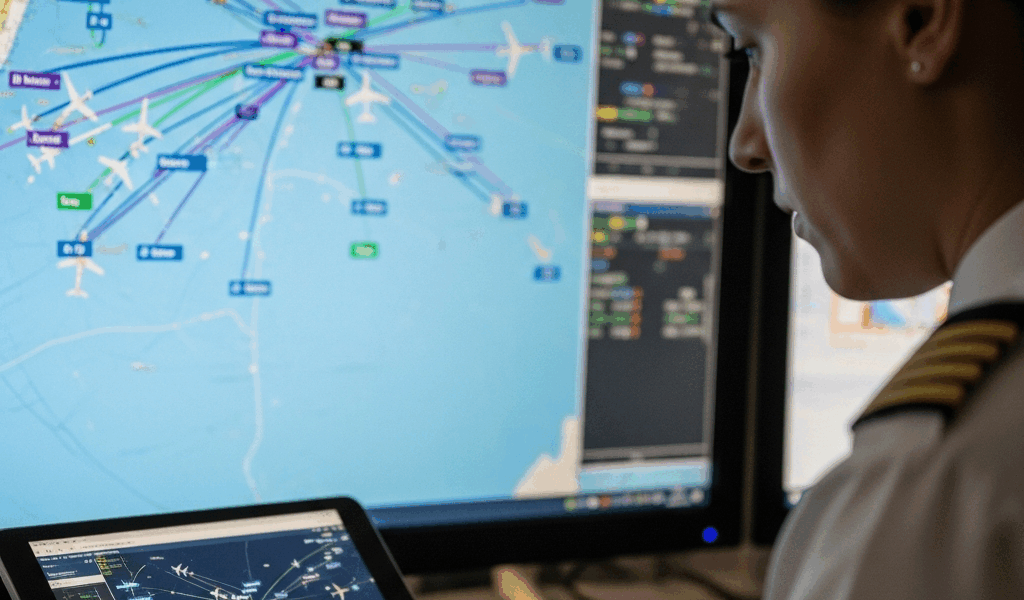
How Airlines Use Real-Time Flight Data to Save Fuel
Airline fuel optimization through flight data isn’t a fringe tech experiment anymore — it’s the difference between a carrier posting profits and one quietly filing for bankruptcy protection. I’ve spent years covering commercial aviation and aerospace systems, and the thing that keeps surprising me isn’t the scale of the savings. It’s how many passengers have no idea any of this is happening 35,000 feet beneath their tray tables. A single wide-body aircraft on a transatlantic route burns roughly 36,000 liters of jet fuel. Every decision made in the cockpit, the operations center, and increasingly inside automated systems affects that number in ways that compound across thousands of flights per year.
The industry burns through approximately 95 billion gallons of jet fuel annually. At even $2.50 per gallon — a conservative figure given recent volatility — that’s nearly $240 billion in fuel costs across global aviation. Shaving 2% off that number with better data isn’t incremental. It’s $4.8 billion. Airlines know this. They’ve known it for years. The question has always been execution.
The Data That Cuts Fuel Bills
Modern commercial aircraft are, first and foremost, data machines. A Boeing 787 Dreamliner generates approximately half a terabyte of data per flight. The GE GEnx-1B engines powering many of those aircraft have around 5,000 sensors each. Temperature readings, vibration signatures, fuel flow rates, pressure differentials — all of it streaming continuously. Most of that data historically sat in maintenance logs. Airlines are now learning to use it in real time.
What the Sensors Actually Track
Fuel flow sensors measure consumption at the engine level, typically accurate to within 0.1% variance. That matters when you’re trying to calculate optimal cruise altitude mid-flight. Air data computers pull in outside air temperature, pressure altitude, and Mach number dozens of times per second. The flight management system — the FMS, which on an Airbus A350 runs on hardware similar to a Thales TopFlight 4000 unit — synthesizes all of this into continuous performance calculations.
Weight and balance sensors, often embedded in the landing gear struts, give precise takeoff weight figures. This isn’t trivial. A 737 carrying 2,000 pounds more than estimated will burn meaningfully more fuel climbing to cruise altitude. Pilots used to rely on load manifests that were sometimes filled out by hand an hour before departure. Now that data feeds directly into pre-flight optimization systems, and it updates if cargo loads change at the last minute.
Real-Time Weather Integration — Where Things Get Interesting
Here’s where I made a mistake early in my reporting on this topic. I assumed weather rerouting was mostly about turbulence avoidance — passenger comfort, liability reduction. That’s part of it. But the primary driver is fuel. Wind is everything in aviation economics.
A 50-knot headwind on a transatlantic crossing can add 45 minutes to flight time and burn an extra 3,000 to 4,500 kilograms of fuel. Airlines now subscribe to weather data services — companies like The Weather Company (an IBM Business) and DTN Aviation provide feeds that update every 15 minutes from a combination of radiosonde balloon data, satellite imagery, and NOAA numerical weather prediction models. These feeds plug directly into flight operations software platforms like Lido/Flight from Lufthansa Systems or Sabre AirCentre.
Surprised by how specific these systems are, a flight dispatcher I spoke with at a major U.S. carrier showed me routing software that had recalculated the optimal track for a Dallas-to-Frankfurt flight three times during a single eight-hour shift, each time responding to updated jet stream position data. The final routing saved an estimated 1,200 kilograms of fuel compared to the original filed flight plan. That’s about $900 in fuel at current prices. On one flight. Multiply across a fleet of 200 aircraft flying long-haul daily.
Step Climbs and Continuous Descent Approaches
Two operational tactics powered by real-time data deserve more attention than they typically get. Step climbs involve an aircraft starting a long flight at a lower altitude — say FL350 — and climbing to FL370 or FL390 as the flight burns off fuel and the aircraft grows lighter. Heavier aircraft are more efficient at lower altitudes; lighter ones do better higher up. The optimal altitude isn’t static. It changes by the hour. FMS systems now calculate the precise moment a step climb delivers net fuel benefit, accounting for the fuel burned during the climb itself.
Continuous Descent Approaches, or CDAs, replace the old stair-step descent pattern — engines at various thrust settings, speed brakes deployed, approach vectors that add distance — with a single smooth, near-idle-thrust glide path from cruise altitude to the runway threshold. A properly executed CDA saves between 150 and 400 kilograms of fuel per landing, depending on aircraft type and descent distance. It also reduces noise. Airports in Europe, particularly Heathrow and Schiphol, have been pushing CDAs aggressively since the early 2010s.
Three Airlines Saving Millions With Flight Data
Probably should have opened with this section, honestly. Numbers land differently than concepts.
Delta Air Lines — Gogo AVANCE and the Predictive Fuel Program
Delta has been among the most publicly transparent about fuel data programs. Their Fuel Smart initiative, which has run in various iterations since the mid-2000s, combines route optimization, weight reduction, and real-time performance monitoring. In 2019 — the last full pre-pandemic year with clean comparative data — Delta reported saving over $1 billion in fuel costs compared to a baseline projection, with data-driven operational decisions accounting for a significant portion of that figure.
One specific program: Delta reduced the weight of its in-flight service carts across its narrowbody fleet by switching to lighter composite materials, saving an average of 400 pounds per aircraft. Doesn’t sound like much. Across 800 daily flights on those aircraft types, it adds up to over 70 million pound-miles of unnecessary weight eliminated per day. Their fuel efficiency team monitors individual tail numbers for anomalies — an aircraft burning 2% more than its fleet average triggers a maintenance review.
Lufthansa Group — Lido/Flight and Winds Aloft Optimization
Lufthansa Group, which includes Swiss International Air Lines, Austrian Airlines, and Brussels Airlines, operates one of the most sophisticated fuel management ecosystems in commercial aviation. They use their own subsidiary’s software — Lido/Flight, developed by Lufthansa Systems — to calculate what they call “fuel-optimal routes” that account for real-time winds, airspace restrictions, and overflight fees simultaneously. Overflight fees matter: routing over Russia versus the North Atlantic involves different cost structures, and the software balances both.
Lufthansa Group has publicly reported annual fuel savings in the range of €200 million to €300 million attributable to operational efficiency measures, with route and trajectory optimization accounting for a substantial share. On individual long-haul flights — say, Frankfurt to Singapore on an Airbus A350-900 — the difference between a suboptimal and an optimized route can reach 2,000 kilograms of fuel, worth roughly €1,400 at current European jet fuel prices.
Alaska Airlines — The Virgin America Integration and What They Learned
Alaska Airlines provides a useful case study in data system integration. After acquiring Virgin America in 2016, Alaska had to harmonize two different fleet management and fuel monitoring systems. The process was messy. Alaska’s operations team has spoken candidly about the 18-month learning curve involved in getting consistent fuel performance data out of the combined fleet.
Once they did, the gains were concrete. Alaska’s fuel efficiency program, which includes real-time weight optimization, single-engine taxi procedures, and APU (Auxiliary Power Unit) usage reduction at the gate, has delivered consistent improvements. Single-engine taxi alone — shutting down one engine on a twin-engine aircraft during ground operations and restarting it just before takeoff — saves approximately 50 to 80 gallons of fuel per flight. Alaska operates roughly 1,200 daily flights. The math is straightforward.
Their fuel savings from single-engine taxi across a full year comes out to somewhere between 22 million and 35 million gallons, depending on fleet mix and average taxi times. At $3 per gallon, that’s between $66 million and $105 million annually from one operational change informed by real-time gate and taxi data feeds.
What This Means for the Future of Flying
Sustainable aviation gets discussed mainly through the lens of sustainable aviation fuel — SAF — and the distant promise of hydrogen or electric propulsion for short-haul routes. Those conversations matter. But data optimization is delivering carbon reductions right now, at scale, without requiring any new propulsion technology or fuel infrastructure.
Carbon Per Passenger Mile — The Metric That Actually Tracks
The useful number isn’t total airline emissions. It’s grams of CO2 per revenue passenger kilometer, or CO2/RPK. This figure accounts for load factors — how full planes are — alongside fuel burn. A half-empty aircraft flying an optimized route can still have worse CO2/RPK than a packed aircraft flying a slightly suboptimal one. Airlines have gotten much better at combining these levers simultaneously.
IATA data shows the global average CO2/RPK fell from approximately 120 grams in 2005 to around 88 grams in 2019, a 27% improvement over 14 years. Real-time fuel optimization contributed to that alongside newer, more efficient aircraft types. The Airbus A320neo burns roughly 20% less fuel per seat than the A320ceo it replaced. Stack operational optimization on top of a more efficient airframe and the numbers compound.
Machine Learning Enters the Cockpit — Slowly
Airlines are beginning to apply machine learning models to fuel prediction and route optimization. GE Aviation’s Digital Solutions division, now part of the Aerospace segment, has deployed ML models that predict fuel burn on specific tail numbers based on maintenance history, engine health data, and historical route performance. The models catch degradation patterns — a compressor blade that’s lost half a percent of efficiency, say — before they show up in traditional maintenance flags.
Airbus’s own Skywise platform, which aggregates flight data from over 10,000 aircraft across hundreds of airline customers, uses this pooled data to benchmark individual aircraft performance. An airline running Skywise can see whether their A330-300 fleet is performing within normal parameters versus the broader operator population. Outliers get investigated. This is fundamentally different from looking at a single airline’s internal data in isolation.
The Passenger Side of the Equation
None of this removes the human element. Pilots still make judgment calls. A captain who adds 2,000 extra kilograms of fuel as a personal buffer — completely legal and sometimes entirely justified — will undermine a software-calculated optimal load. Airlines know this. The better ones have moved toward collaborative decision-making processes where dispatchers and flight crew review the data together rather than the system simply issuing a fuel load recommendation from a black box.
What’s changed in the last decade is the quality of the conversation. Dispatchers can now show a pilot exactly why a specific fuel figure was calculated, what the weather models show, where the alternate airports sit, and what the cost differential is between adding 1,000 kilograms of buffer versus 3,000. That transparency builds trust in the system. And trust in the system is what actually drives the savings.
The next decade will push further into real-time airspace optimization — dynamic routing that updates in-flight every few minutes rather than once at departure — and tighter integration between airline ops centers and air traffic management systems. NASA’s ATM-X research program and EUROCONTROL’s SESAR initiative are both building the infrastructure for this. The data infrastructure already exists. The regulatory and coordination frameworks are catching up.
Flying is going to keep getting more data-intensive. The fuel bills will keep coming down. And somewhere over the Atlantic tonight, an algorithm is quietly rerouting a 787 around a jet stream trough, saving 900 kilograms of fuel and 2.8 metric tons of CO2, and nobody on board has any idea it happened.


Stay in the loop
Get the latest aerodata updates delivered to your inbox.