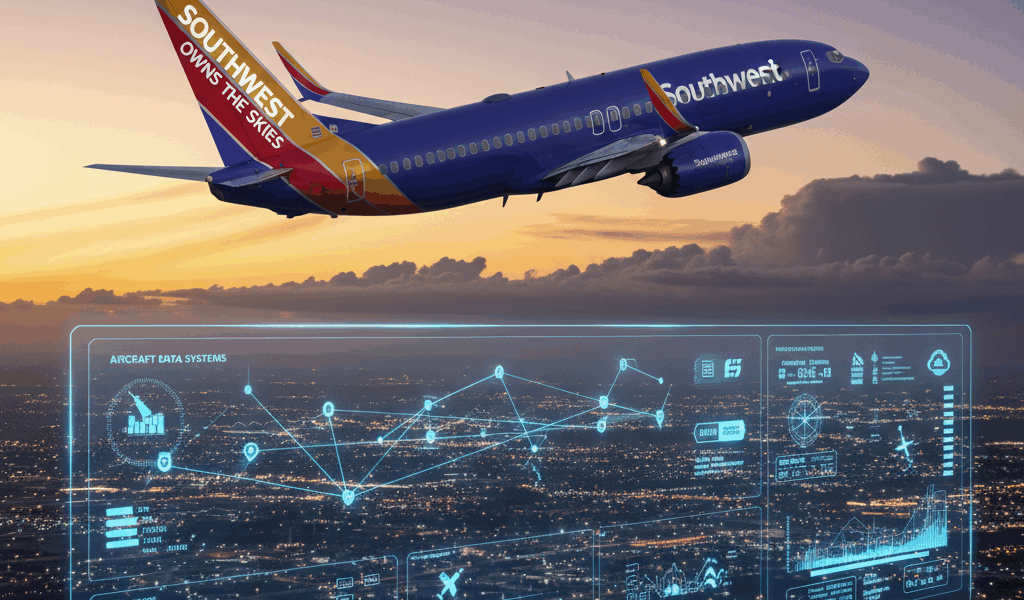
Southwest Airlines operates the world’s largest Boeing 737 fleet with over 800 aircraft, all variants of the single-aisle type that has defined the carrier since its founding. This fleet concentration represents both competitive advantage and strategic constraint.
The Fleet Profile
Southwest’s current fleet comprises approximately 770 active 737s with 50+ in storage or undergoing modification. The fleet includes 737-700s, 737-800s, and an expanding 737 MAX 8 fleet. The MAX 7, Southwest’s intended 737-700 replacement, awaits final certification before deliveries commence.
The carrier operates the world’s most homogeneous major airline fleet. Every aircraft shares common type rating, enabling any Southwest pilot to operate any company aircraft without additional training. Maintenance tooling, spare parts inventory, and technical expertise focus entirely on 737 systems. This simplicity drives significant operational and cost advantages.
Economic Benefits of Standardization
Fleet commonality generates substantial savings. Training costs drop when pilots and mechanics learn one type rather than multiple. Inventory investment decreases when spare parts serve the entire fleet rather than type-specific components. Crew scheduling gains flexibility when any qualified pilot can operate any company aircraft.
Industry estimates suggest fleet standardization saves 5-10% on direct operating costs compared to mixed-fleet operators. For Southwest’s scale, this translates to hundreds of millions annually. The airline consistently reports among the industry’s lowest unit costs, with fleet strategy contributing meaningfully to this performance.
Operational Flexibility
Single-fleet operation enables extraordinary operational flexibility. When disruptions occur, Southwest can substitute any available aircraft on any route without consideration for type certification or crew qualification. A 737 MAX 8 can replace a 737-700 with minimal operational adjustment.
This flexibility proved valuable during the 737 MAX grounding. Southwest, the MAX’s largest operator with 34 grounded aircraft, adapted by increasing utilization on its remaining fleet. The common type rating meant no crew requalification as aircraft shifted between routes and assignments.
Strategic Limitations
Standardization creates constraints. Southwest cannot serve markets requiring range beyond 737 capability. Transatlantic ambitions, occasionally discussed, would require widebody acquisition and the complexity that entails. Hawaiian operations, announced in 2019, pushed the 737’s range limits.
Aircraft availability risk concentrates in a single type. The MAX grounding removed 10% of available capacity. A hypothetical systemic 737 issue would ground Southwest’s entire operation. Diversified fleets provide insurance against type-specific problems that Southwest foregoes.
Growth and Fleet Planning
Southwest has committed to over 700 additional 737 MAX orders, extending the standardization strategy for decades. The MAX 8 replaces older 737-800s, offering 14% fuel efficiency improvement. The MAX 7, smaller than the MAX 8, will eventually replace the 737-700 in Southwest’s fleet.
Production delays have affected planning. Boeing’s MAX production rate limitations defer Southwest’s fleet renewal timeline. The airline has extended older aircraft service life while awaiting deliveries, temporarily increasing fleet age against preferred strategy.
Competitive Implications
Southwest’s fleet scale provides procurement leverage. As the 737’s largest customer, Southwest commands attention from Boeing and suppliers. Order negotiations benefit from volume discounts unavailable to smaller operators. This buying power partially offsets risks of single-supplier dependence.
Competitors have studied Southwest’s model without replication. Most major carriers operate mixed fleets, accepting complexity costs for capability breadth. The unique circumstances of Southwest’s network and business model enable standardization that wouldn’t translate to different operational profiles.
The Future of Fleet Strategy
Southwest’s 737 commitment extends through the 2040s based on current orders. Any successor aircraft would need to maintain type commonality or force Southwest to accept the complexity it has avoided for 50 years. Boeing’s next narrowbody program, whenever launched, will be designed with Southwest’s requirements prominently considered.
The airline’s fleet strategy represents more than operational preference; it defines corporate identity. Southwest is the 737 airline, and the 737 is Southwest’s aircraft. This mutual identification benefits both parties while creating interdependence that constrains strategic flexibility. The skies belong to Southwest partly because Southwest committed completely to the sky’s most numerous aircraft.
Subscribe for Updates
Get the latest articles delivered to your inbox.
We respect your privacy. Unsubscribe anytime.