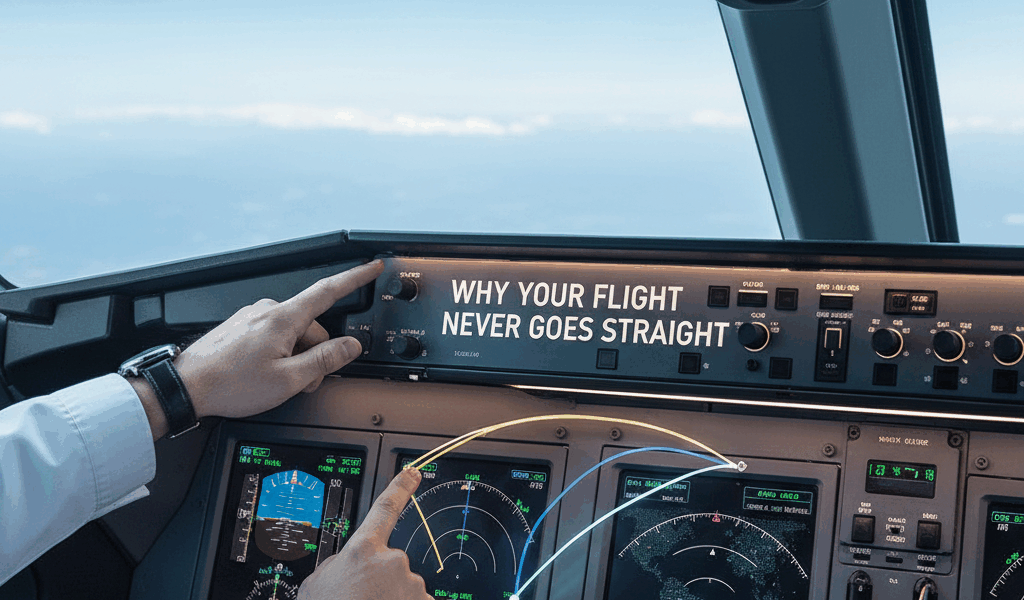
Look at any flight tracking app and you’ll notice something curious: aircraft rarely fly the direct great-circle route between origin and destination. The seemingly inefficient paths actually represent complex optimization across multiple competing constraints. Your flight never goes straight for very good reasons.
The Great Circle Reality
The shortest distance between two points on a sphere follows a great circle arc. New York to London’s great circle distance measures 5,567 kilometers. Yet actual flights routinely travel 5,800-6,200 kilometers depending on conditions. This 4-11% deviation represents intentional routing decisions, not navigational imprecision.
Wind patterns dominate routing calculations. The North Atlantic jet stream regularly exceeds 200 kilometers per hour during winter months. Eastbound flights ride this river of fast-moving air, accepting indirect routing to gain tailwind advantage. Westbound flights route further south or north to minimize headwind exposure. The fuel saved from optimal wind positioning far exceeds the cost of additional distance.
The Organized Track System
North Atlantic airspace presents unique challenges. Approximately 2,000 flights daily cross between North America and Europe through airspace lacking radar coverage. The Organized Track System creates parallel highway-like routes across the ocean, spaced 60 nautical miles apart laterally and 1,000 feet vertically.
These tracks shift daily based on forecast wind patterns. The North Atlantic Tracks Planning Team publishes new routes twice daily, optimizing for prevailing conditions. Airlines request preferred tracks, and air traffic control assigns specific routes balancing traffic flow with operator preferences. The result: standardized routing that prevents the chaos of individual aircraft choosing optimal paths that might conflict.
Airspace Restrictions
Sovereign airspace creates routing constraints invisible on maps. Overflight of certain countries requires diplomatic permission, fees, or is prohibited entirely. Russian airspace closure in 2022 added 2-4 hours to many routes between Europe and Asia. Flights now route around rather than across, burning additional fuel and crew duty time.
Military airspace, temporary flight restrictions, and special use areas create domestic routing constraints. A direct path might transit restricted areas requiring significant altitude changes or timing coordination. Routing around adds distance but provides operational simplicity.
Economic Optimization
Airlines optimize routes for total cost, not minimum distance. Fuel represents the largest variable cost, but overflight fees can significantly impact economics. Flying direct over expensive airspace might cost more than the fuel savings justify. Route optimization systems calculate cost-per-kilometer for each airspace segment, identifying the minimum total cost path.
Canadian overflight fees, for example, prompted some carriers to route U.S. transcontinental flights through extreme northern or southern corridors. The additional fuel burn proved cheaper than the navigation service charges. Similar calculations occur globally, with airlines balancing fuel, fees, and crew costs.
Weather Avoidance
Convective weather, turbulence, and icing conditions require routing deviations. Aircraft equipped with weather radar detect precipitation and adjust paths accordingly. The indirect routing you observe often represents real-time avoidance of conditions that would compromise safety or passenger comfort.
Flight dispatch offices continuously monitor weather developments, providing recommended routings before departure and updates enroute. Major deviations require coordination with air traffic control, who must ensure separation from other aircraft. The seemingly erratic paths visible on tracking apps reflect complex negotiations between optimal routing and real-time conditions.
Terrain and Emergency Considerations
Extended-range twin-engine operations (ETOPS) regulations require aircraft to remain within specified flying time of suitable emergency airports. Transoceanic routes must thread between these ETOPS circles, sometimes deviating from direct paths to maintain emergency diversion options.
Mountainous terrain imposes additional constraints. Minimum safe altitudes require specific routings in regions like the Himalayas or Andes. Engine-out drift-down calculations determine whether direct routing remains safe or whether longer paths around high terrain are required.
The Optimization Computer
Modern flight planning systems evaluate millions of potential routes to identify optimal solutions. Wind data, airspace costs, available altitudes, aircraft performance, and regulatory requirements all factor into the calculation. The process that once required hours of manual work now completes in seconds.
The next time you watch your flight tracker show an indirect path, recognize the sophisticated optimization behind that routing. Your flight never goes straight because straight is rarely best. The winding path represents aviation’s response to a complex operational environment where distance is just one variable among many.
Subscribe for Updates
Get the latest articles delivered to your inbox.
We respect your privacy. Unsubscribe anytime.