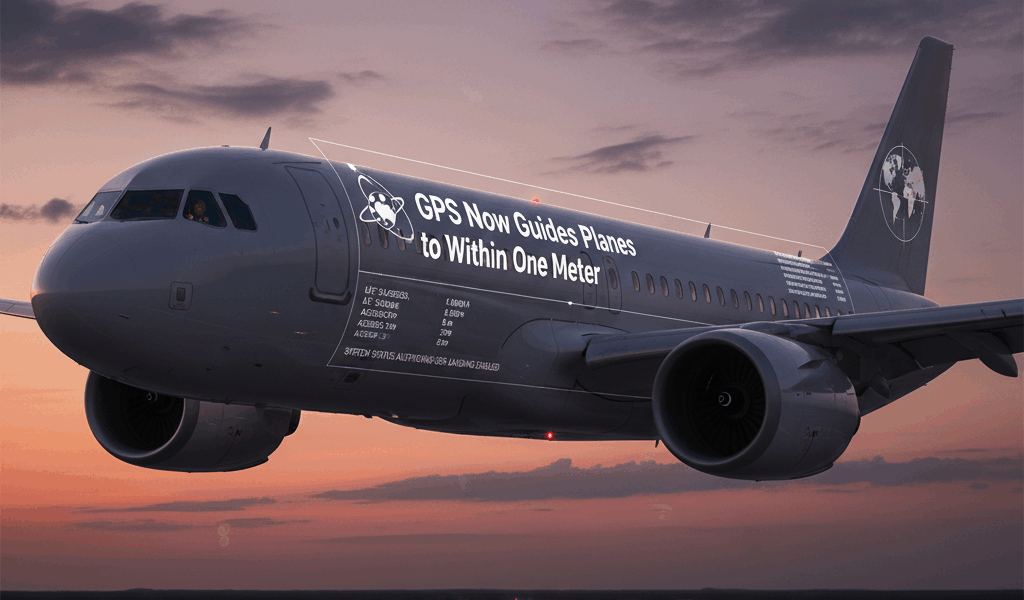
GPS Now Guides Planes to Within One Meter

Global navigation satellite systems have achieved what seemed impossible just decades ago: positioning accuracy of approximately one meter anywhere on Earth’s surface. For aviation, this precision has fundamentally transformed how aircraft navigate the skies and approach runways.

The GPS Revolution in Aviation

The Global Positioning System constellation consists of 31 operational satellites orbiting 20,200 kilometers above Earth. Each satellite broadcasts precise timing signals that receivers use to calculate position through trilateration. With signals from four or more satellites, an aircraft can determine its three-dimensional position to remarkable accuracy.

Standard GPS provides position accuracy of approximately 5-10 meters, sufficient for enroute navigation but inadequate for precision approaches. The aviation industry developed augmentation systems to achieve the sub-meter precision required for critical phases of flight.

Augmentation Systems Explained

The Wide Area Augmentation System (WAAS) uses a network of precisely surveyed ground reference stations to detect GPS errors and broadcast corrections. These corrections account for atmospheric delays, satellite orbital errors, and clock discrepancies. WAAS-enabled receivers achieve lateral accuracy of 1-2 meters and vertical accuracy of 2-3 meters.

Ground-Based Augmentation Systems (GBAS) take precision further. By placing reference receivers at airports, GBAS provides corrections specific to the local environment. Aircraft equipped with GBAS receivers can execute approaches with lateral guidance accurate to 0.4 meters and vertical guidance accurate to 0.6 meters. This matches or exceeds the precision of traditional Instrument Landing Systems.

From Beacons to Satellites

The transformation represents a fundamental shift in navigation philosophy. Traditional navigation relied on ground-based beacons: VORs broadcasting radials, DME stations providing distance, ILS localizers and glideslopes guiding approaches. This infrastructure required thousands of transmitters, each demanding installation, calibration, and continuous maintenance.

Satellite navigation replaces ground infrastructure with space-based signals available globally. The cost implications are staggering. A single ILS installation costs $1-2 million with $100,000+ annual maintenance. WAAS approach capability requires only updated avionics on the aircraft, with system-wide ground infrastructure shared across the entire national airspace.

Operational Benefits

Precision satellite navigation enables approaches to runways lacking ground-based navigation aids. Over 4,000 U.S. airports now have WAAS approaches, compared to approximately 1,300 with ILS. Remote airports, previously accessible only in good weather, now support instrument operations.

Required Navigation Performance (RNP) procedures leverage satellite precision for optimized flight paths. Aircraft can fly curved approaches threading through terrain that would be impossible with traditional straight-in procedures. RNP reduces flight distances, lowers fuel consumption, and decreases noise exposure for communities near airports.

Global Constellation Diversity

Aviation no longer depends solely on GPS. The European Galileo system now provides 30 operational satellites with aviation-certified signals. Russia’s GLONASS constellation adds 24 satellites. China’s BeiDou system operates 35 satellites providing global coverage. Modern avionics receive signals from multiple constellations simultaneously, improving accuracy and reliability through redundancy.

Multi-constellation receivers routinely track 20+ satellites simultaneously. This abundance enables continued navigation even if entire constellations experience failures. The geometric diversity of satellite positions from multiple systems also improves vertical accuracy, critical for precision approaches.

The Meter-Level Future

Emerging Dual-Frequency Multi-Constellation receivers promise still greater precision. By receiving signals on multiple frequencies, these systems can directly measure and correct for ionospheric delays rather than relying on modeled corrections. Position accuracy better than 0.5 meters becomes routinely achievable.

Applications extend beyond navigation. Precise positioning enables autonomous ground movement systems guiding aircraft along taxiways without controller instruction. Unmanned aircraft systems depend on meter-level accuracy for operations in congested airspace. Future urban air mobility vehicles will navigate between buildings using positioning precision measured in centimeters.

The Vulnerability Question

Dependence on satellite navigation creates vulnerabilities. GPS signals are remarkably weak, easily jammed by inexpensive equipment or spoofed by sophisticated adversaries. Aviation regulators require backup navigation capability, with traditional ground-based systems maintained even as satellite navigation becomes primary.

Research continues into alternative positioning technologies: enhanced inertial systems, signals of opportunity, and terrain-referenced navigation. The goal is resilient positioning that degrades gracefully when satellite signals become unavailable or unreliable.

One meter from anywhere represents both achievement and challenge. The precision exists, transforming aviation operations globally. Ensuring that precision remains available, reliable, and trusted remains an ongoing imperative for the industry.

Jason Michael

Jason Michael

Author & Expert

Jason Michael is a Pacific Northwest gardening enthusiast and longtime homeowner in the Seattle area. He enjoys growing vegetables, cultivating native plants, and experimenting with sustainable gardening practices suited to the region's unique climate.

3 Articles
View All Posts

Subscribe for Updates

Get the latest articles delivered to your inbox.