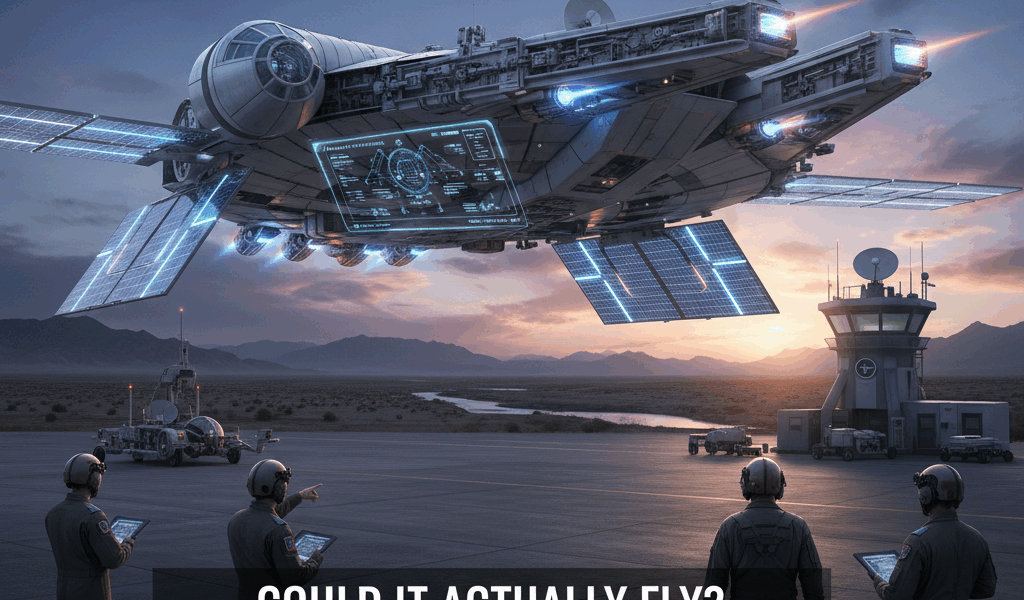
The Millennium Falcon is the most famous fictional spacecraft in cinema history—a battered YT-1300 Corellian light freighter that made the Kessel Run in less than twelve parsecs. But could this iconic ship actually fly? Analyzing its design through the lens of real aerospace engineering reveals fascinating insights about what works, what doesn’t, and what we might borrow for future spacecraft.
The Aerodynamics Problem

The Falcon’s saucer-shaped design would be catastrophic in any atmosphere. That flat, wide profile creates massive drag and provides almost no lift. Real aircraft need carefully designed airfoils—wings curved to create pressure differentials that generate lift. The Falcon’s shape would handle like a flying dinner plate.
However, in the vacuum of space, aerodynamics don’t matter. There’s no air resistance, no need for lift. The Falcon’s design actually makes more sense for a spacecraft that spends most of its time in vacuum, occasionally braving atmospheric entry for planetary landings.
The ship’s heat shields would need to be extraordinary. Atmospheric reentry generates temperatures exceeding 3,000°F on the Space Shuttle’s leading edges. The Falcon apparently handles this routinely while also absorbing blaster fire—suggesting materials far beyond anything in our current arsenal.
Propulsion: What Could Power This Thing?
The Falcon’s sublight engines—those distinctive blue-glowing exhausts at the rear—would require propulsion systems beyond our current technology. The ship accelerates from standstill to escape velocity in seconds, implying thrust-to-weight ratios that dwarf anything we’ve built.
Consider the numbers: escaping Earth’s gravity requires reaching about 25,000 mph. The Space Shuttle’s main engines, among the most powerful ever built, produce about 400,000 pounds of thrust each. To accelerate a ship the Falcon’s apparent mass that quickly would require engines producing tens of millions of pounds of thrust.
Ion propulsion, which we do use on real spacecraft, provides highly efficient thrust but extremely low acceleration—taking months to build speed. Nuclear thermal rockets offer better performance but still nothing approaching what the Falcon demonstrates. Some form of matter-antimatter annihilation or exotic physics would be required.
The Hyperdrive: Breaking Physics As We Know It
The Falcon’s hyperdrive—enabling faster-than-light travel—violates Einstein’s special relativity, which establishes the speed of light as an absolute cosmic speed limit. As an object approaches light speed, its mass increases toward infinity, requiring infinite energy to accelerate further.
However, theoretical physics offers potential loopholes:
Alcubierre Drive: Physicist Miguel Alcubierre proposed a warp drive that contracts space ahead of a ship and expands it behind, effectively moving the bubble of space itself rather than accelerating the ship through space. The ship wouldn’t exceed light speed locally, but could arrive at distant destinations faster than light traveling the normal way.
The catch: Alcubierre’s math requires “exotic matter” with negative energy density—something that may not exist and would require energy equivalent to Jupiter’s mass to create if it did.
Wormholes: General relativity permits the existence of wormholes—shortcuts through spacetime connecting distant points. If the Falcon’s hyperdrive creates or navigates wormholes, faster-than-light travel becomes theoretically possible.
The challenges: keeping a wormhole open would require the same problematic exotic matter, and navigating one would likely involve encountering crushing gravitational forces.
Artificial Gravity Without the Spin
Characters walk normally inside the Falcon regardless of acceleration or orientation—implying artificial gravity. Real spacecraft create “gravity” through rotation (centrifugal force) or constant acceleration. The Falcon does neither.
Creating gravity without rotation or acceleration would require manipulating spacetime itself—bending it to create a gravitational field. This is pure science fiction with no theoretical pathway in known physics.
Alternatively, the Star Wars universe might employ some form of inertial dampening that prevents occupants from feeling acceleration effects, combined with magnetized floors or similar technology. But true artificial gravity remains beyond our understanding.
What Actually Makes Sense
Despite the impossible elements, some Falcon features align reasonably well with real aerospace engineering:
Modular Design: The Falcon is famously modified, with Han Solo’s customizations making it faster than stock. Real spacecraft are increasingly designed for modularity—the International Space Station was assembled from modules, and future spacecraft will likely be even more adaptable.
Redundant Systems: The hyperdrive fails constantly, but the Falcon keeps flying on backup systems. Real spacecraft employ extensive redundancy—critical systems often have triple backups. The Space Shuttle had five redundant computers.
Cargo Configuration: As a freighter, the Falcon’s design prioritizes cargo capacity. The central corridor and surrounding holds make practical sense for loading and unloading. Real cargo spacecraft like the SpaceX Dragon use similar interior layouts.
Cockpit Offset: The Falcon’s cockpit sits on the starboard side rather than centerline—seemingly awkward but actually practical for docking alongside other vessels and stations. Real spacecraft sometimes employ similar asymmetric designs for specific operational requirements.
The Cockpit Design
The Falcon’s cockpit is surprisingly well-designed from a human factors perspective. The pilot and co-pilot sit side-by-side with good visibility. Controls appear to be within easy reach. The layout allows both crew members to access critical systems.
Real spacecraft cockpits have evolved toward similar philosophies. Early capsules crammed astronauts into minimal spaces with controls scattered wherever they’d fit. Modern designs—SpaceX’s Crew Dragon, Boeing’s Starliner—prioritize ergonomics and visibility.
The Falcon’s forward-facing transparencies (windows) wouldn’t survive real space travel. Radiation, micrometeoroids, and thermal stress would require far more protection. Real spacecraft use small, heavily reinforced viewports or cameras and screens. But for a movie, windows work better cinematically.
Energy Requirements
The Falcon’s power generation remains mysterious but would need to be extraordinary. Consider the energy required to:
- Power sublight engines capable of planetary escape in seconds
- Operate a hyperdrive
- Maintain life support for extended journeys
- Power weapons systems capable of destroying TIE fighters
- Run shields that absorb direct hits
- Generate artificial gravity throughout the ship
A fusion reactor might theoretically provide sufficient power density, but containing and controlling fusion reactions remains challenging—ITER, the international fusion project, won’t achieve sustained fusion until the 2030s at earliest, and scaling that technology to fit in a small starship is far beyond current engineering.
What We’re Actually Building
Real spacecraft development, while less dramatic than the Falcon, is advancing rapidly:
SpaceX Starship: The largest and most powerful rocket ever built, designed for Mars missions. Still uses chemical propulsion but represents a major leap in capability.
Nuclear Thermal Propulsion: NASA and DARPA are developing nuclear thermal rockets that could cut Mars transit time from 7-9 months to approximately 3-4 months.
Ion Propulsion: Already used on deep space probes, ion engines provide extraordinary efficiency for long-duration missions.
Solar Sails: Using light pressure for propulsion, solar sails could eventually enable interstellar travel—though journeys would take decades or centuries.
The Verdict
Could the Millennium Falcon actually fly? In atmosphere—barely, and only with extraordinary thrust to compensate for its aerodynamic deficiencies. In space using sublight engines—theoretically possible with propulsion technology far beyond our current capabilities. Using hyperdrive—not according to physics as we currently understand it, though theoretical loopholes exist.
The Falcon remains firmly in the realm of science fiction. But its cultural impact on space enthusiasm is very real. Generations of engineers, scientists, and astronauts cite Star Wars as inspiration for their careers. Sometimes the impossible dream is exactly what we need to push toward the merely difficult.
Key Takeaways
- The Falcon’s saucer shape would be aerodynamically disastrous in atmosphere but doesn’t matter in space
- Sublight acceleration shown in films would require propulsion millions of times more powerful than current technology
- Faster-than-light travel violates known physics, though theoretical concepts like Alcubierre drives offer conceptual paths forward
- Some Falcon features—modularity, redundancy, cockpit ergonomics—align well with real spacecraft design principles
- Real spacecraft development is advancing rapidly, even if we’re far from matching science fiction capabilities
Analysis based on aerospace engineering principles, published physics research, and Star Wars technical specifications from official sources.



Stay in the loop
Get the latest aerodata updates delivered to your inbox.